Covered Calls on Dividend Stocks: How to Multiply Your Dividend Income
How to sell covered calls on dividend stocks to earn option premium on top of your dividends. Strike and expiration picks, a real Apple example, and the ex-dividend risk.
- Outlook
- Neutral to slightly bullish
- Legs
- 100 shares + 1 short call
- Max profit
- Premium + (strike − cost)
- Max loss
- Cost − premium (stock to $0)
- Capital
- 100 shares
Key takeaways
- A covered call pays you premium on shares you already own, on top of the dividend.
- I aim for 30 to 45 days to expiration and a delta around 0.20 to 0.30.
- The real risk is the stock itself. The premium only softens a drop, and your upside is capped at the strike.
- Watch the ex-dividend date. An in-the-money call can get assigned the day before, and then you don't get the dividend.
Before you start: read Covered Call Strategy and The Complete Delta 101 Guide first.
If you’re a dividend investor, you’re probably already holding 100 shares or more of a few good companies and collecting a small check every quarter. What I want to show you here is a simple options strategy that can put a lot more money on top of that dividend, using the exact same shares.
It’s the covered call. Honestly, it’s probably one of the most boring strategies in options. Nobody brags about covered calls. But it’s simple, you can start today even if you’ve never traded an option, and for long-term investors it’s one of the most practical ways to earn more from stocks you already own.
What is a covered call?
A covered call means you own 100 shares of a stock and you sell one call option against them.
When you sell that call, someone pays you a premium. In return, you agree to sell your 100 shares at a set price (the strike price) if the stock is above it by the expiration date.
That’s it. If you just hold a stock, it doesn’t pay you anything until you sell it, apart from the dividend. A covered call lets those same 100 shares earn you something every month or so. I go deeper on the basics in my covered call guide.
Why it works so well with dividend stocks
Let me show you with the numbers from my video. Back in February 2024, Apple was trading at about $182. Apple paid $0.24 a share every quarter, so 100 shares got you about $96 a year in dividends.
One covered call, 185 strike, about 40 days out, paid $3.70. Every option covers 100 shares, so that’s $370.
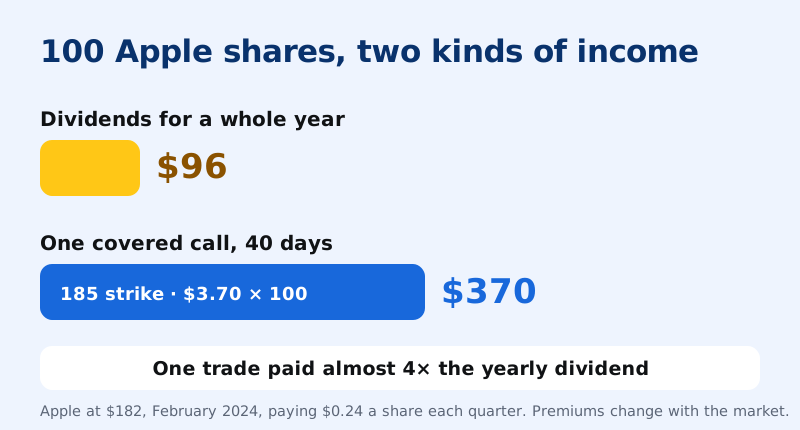
So one trade paid almost four times what the dividend pays in a whole year. And you still get the dividend too, as long as you hold the shares. That’s what I mean by multiplying your dividend income.
Now, premiums change a lot with the market. When things are calm you’ll get less, when volatility is high you’ll get more. But this is the basic idea.
Here’s what else I like about covered calls on dividend stocks:
- It’s passive. You don’t need to sit in front of the screen. Placing the trade takes five minutes, and then you wait.
- It’s a small hedge. If a stock has run up a lot and you’re worried it pulls back, selling a call locks in some of that gain and the premium cushions a small drop.
- You get paid twice. The dividend and the premium, from the same shares.
When should you sell covered calls?
The best setup is when you’re bullish on the stock long-term, but you don’t expect a big move up in the next month or so. Neutral, or even slightly down, in the short term.
That’s why dividend stocks fit so well. Most of them are steady, mature companies. You plan to hold them for years anyway, and they usually don’t jump 20% in a month.
All you need is 100 shares of the stock. If you have 200 shares, you can sell two contracts, and so on.
How I pick the strike and expiration
The two things you have to decide when selling a covered call are the expiration date and the strike price.
Expiration: 30 to 45 days. That’s the ideal range, because that’s where time decay starts to speed up, so the option loses value fastest while you’re holding it. I personally sell weeklies a lot of the time, but if you want to keep it relaxed, 30 to 45 days is the sweet spot.
Strike: around 0.20 to 0.30 delta. Delta roughly tells you the chance of the stock finishing above your strike. A 0.20 delta call gives the stock room to go up before your shares get called away, and still pays a decent premium. If you’re not sure what delta is, read my delta guide first.
In my Apple example I went a bit closer, with the 185 strike when Apple was at $182. Closer strikes pay more premium, but there’s a higher chance your shares get sold. It’s always that trade-off.
The Apple example, step by step
Let’s say you bought 100 shares of Apple at $180, and it’s trading at $182 now.
- Go to Apple’s option chain and choose Sell and Call. You’re selling, not buying.
- Pick an expiration around 30 to 45 days out. I picked one about 40 days away.
- Pick the strike. I went with 185.
- The price shows $3.70. Multiply by 100 and that’s the $370 you collect.
- Review the order and submit.
One thing that confuses people on Robinhood: it shows the max loss as “unlimited”. That’s because the app looks at the call on its own. Since you own the shares, the call is covered, so it’s not an unlimited loss for you. I walk through every screen in how to sell covered calls on Robinhood, and the steps are pretty much the same on any other broker.
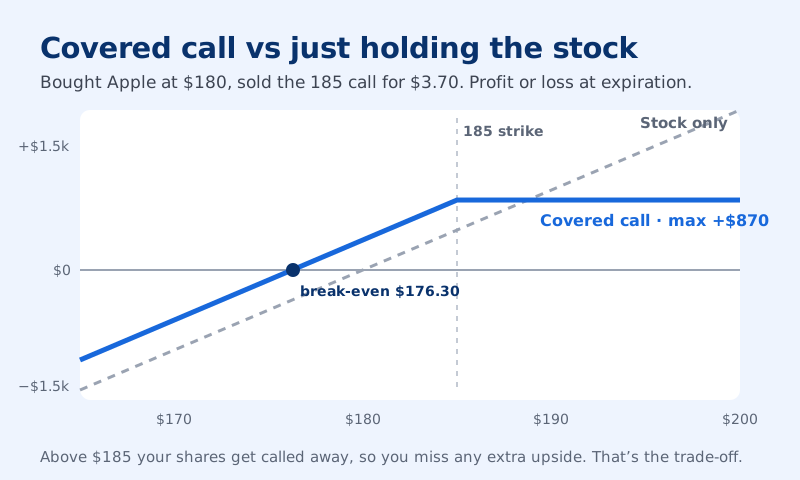
Here’s how the trade pays off at expiration compared with just holding the shares:
And these are the three ways it can play out:
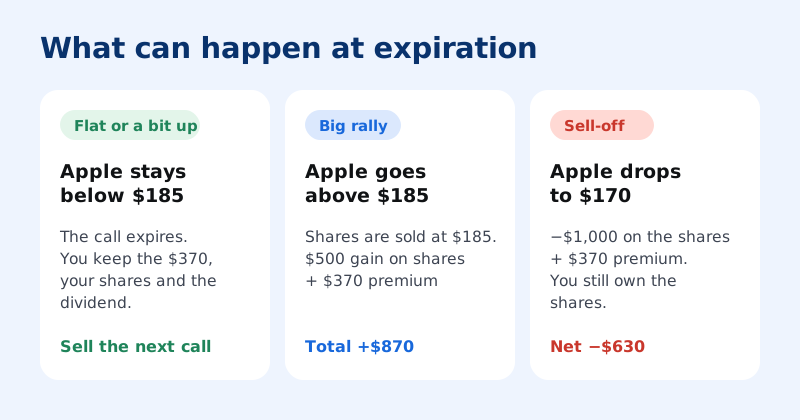
If Apple stays under $185, the call just expires. You keep the $370, you keep your shares, and you sell another call for the next month.
If Apple goes above $185, your shares get sold at $185. You make $5 a share on the stock ($500) plus the $370 premium, so $870. Not bad at all. You just miss anything above $185.
The risk people don’t talk about
In my video I called this low risk, and compared to most options strategies it is. But I want to be clear about where the risk really is: it’s in owning the stock.
If Apple drops from $180 to $170, you’re down $1,000 on the shares. The $370 premium brings that down to $630, but you’re still down. The premium softens a drop, it doesn’t stop one. That’s why I only sell covered calls on stocks I’m happy to hold for years, which for most dividend investors is the whole point anyway.
The other cost is the capped upside. If the stock suddenly rallies 15%, you only get up to your strike. For me that’s fine on a steady dividend stock, but it’s something to accept before you place the trade.
Watch the ex-dividend date
This is the one thing that’s specific to dividend stocks, and I didn’t get into it in the video.
To get a dividend, you have to own the shares before the ex-dividend date. If your call is in the money right before that date, the person who bought your call might exercise it early just to grab the dividend. That usually happens the day before the ex-dividend date. Your shares get sold at the strike, and you don’t get that dividend.
It mostly happens when the dividend is bigger than the time value left in the call. A few ways I avoid it:
- Check when the next ex-dividend date is before you sell the call.
- Stick to out-of-the-money strikes. If the stock is far below your strike, early assignment basically doesn’t happen.
- If your call is in the money a few days before the ex-dividend date and you want to keep the shares, roll it out to a later date or a higher strike.
One more thing on taxes. Selling calls that are deep in the money can affect whether your dividends count as qualified, which is the lower tax rate. Out-of-the-money calls with more than 30 days left are generally the safe kind. I’m not a tax professional, so if dividends are a big part of your income, check this with one. I also covered the main options tax traps in options trading taxes.
Which dividend stocks work best?
I look for the same things I look for in the wheel strategy:
- A stock I’d hold anyway. This is the most important one. Never buy a stock just for the premium.
- Liquid options. A tight bid-ask spread and plenty of open interest, so you get a fair price.
- Not too volatile. Wild stocks pay big premiums for a reason. Steady dividend payers are calmer, so you’re less likely to get your shares called away by a sudden jump.
- 100 shares you can afford. Covered calls need 100 shares per contract. If that’s too expensive, look at the poor man’s covered call.
That’s really all there is to it. If you’re a long-term dividend investor, a covered call is the simplest way to start using options, and it can add a lot to the income you already get. If you have questions, put them in the comments on the video and I’ll answer them.
FAQ
Can you sell covered calls on dividend stocks and still get the dividend?
Yes. You get the dividend as long as you still own the shares at the ex-dividend date. The only time you miss it is if your call is assigned before then, which usually happens when the call is in the money right before the ex-dividend date.What happens to a covered call on the ex-dividend date?
Nothing, in most cases. But if your call is in the money and the dividend is bigger than the time value left in the option, the buyer may exercise early, usually the day before the ex-dividend date. Your shares are sold at the strike and you don't get that dividend.What strike and expiration should I use for covered calls on dividend stocks?
A common starting point is 30 to 45 days to expiration with a strike around 0.20 to 0.30 delta. That keeps a decent premium while giving the stock room to rise before the shares get called away.Are covered calls on dividend stocks risky?
The option itself doesn't add much risk, but you still own the stock. If it falls a lot, the premium only covers a small part of the loss. The other cost is that your upside is capped at the strike if the stock rallies.Check your understanding
Written by Abhi
I'm Abhi. I've invested in US stocks for years, and for the last five to six years options have been at the heart of how I trade. I started AD Finance to break complex options concepts into plain-English guides, so you can trade with confidence, and I built OptionsVault to track my own trades.
This guide is for education only and is not financial advice. Options trading involves risk. Read the full disclaimer.