Key takeaways
- Options on stocks and ETFs (including SPY and QQQ) are almost always short-term, so they get taxed like your salary.
- Index options like SPX get the 60/40 split: 60% long-term, 40% short-term, even if you held them for a day.
- Buy the same stock or option back within 30 days before or after a losing sale and the loss gets pushed out. That's the wash sale rule.
- Form 8949 has every trade on it. Check the cost basis before you file.
Before you start: read Trading Options 101 first.

Tax time sneaks up on options traders every year. You place a lot of trades, weekly and monthly expiries keep adding up, and then the 1099 shows up with one big number you have to pay tax on.
I made a video on this right before the April deadline, after getting a lot of questions on my older 1099 video. This post is the written version, with a bit more detail. There are three things I always check on my own forms before I file, because each one can save you real money or at least stop a surprise later.
Quick note: I’m an options trader, not a tax professional. I do my own taxes and this is what I look at. For your own situation, talk to a tax advisor.
How are options taxed? Short-term vs long-term
Very quickly, because everything below builds on this. Options are taxed as capital gains, and it all comes down to how long you held the position.
If you buy something and sell it within a year, it’s a short-term gain. That gets added on top of your regular income and taxed at your normal bracket. So let’s say you earn $100K. Your short-term gains get taxed like extra salary, which for a lot of people is 22% or 24%.
If you hold something for more than a year, it’s a long-term gain, and the IRS is much nicer about it. For most people that’s 15%.
Now here’s the thing with options. Almost nobody holds an option for a year. I trade weekly and monthly expiries myself, so pretty much all of it is short-term. That’s why the first point matters so much.
Mistake 1: Not knowing SPX and SPY options are taxed differently
If you trade options on a regular stock like Tesla or Apple, the gain is taxed as a normal short-term gain. Same for ETF options like SPY and QQQ. A lot of people get this one wrong: SPY tracks the S&P 500, but it’s still an ETF, so SPY options are taxed like stock options.
Index options are different. SPX, XSP, NDX, RUT and VIX options are what the IRS calls Section 1256 contracts, and they get the 60/40 tax rule. Out of your gain, 60% is taxed as long-term and only 40% as short-term. It doesn’t matter if you held the trade for a year or for 20 minutes.
Let’s say you made $10,000 and you’re in the 24% bracket:
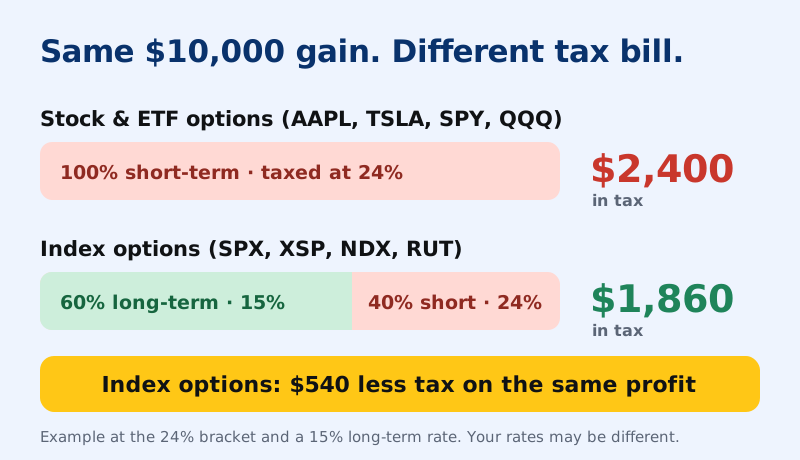
Same profit, $540 less tax. And the higher your bracket, the bigger that gap gets. This is a big reason I trade SPX instead of SPY for things like my iron condors.
A couple of other things about index options:
- Anything still open on December 31 is treated as if you closed it at that day’s price. It’s called mark-to-market. So you pay tax on open index trades too, and your cost basis resets for the new year.
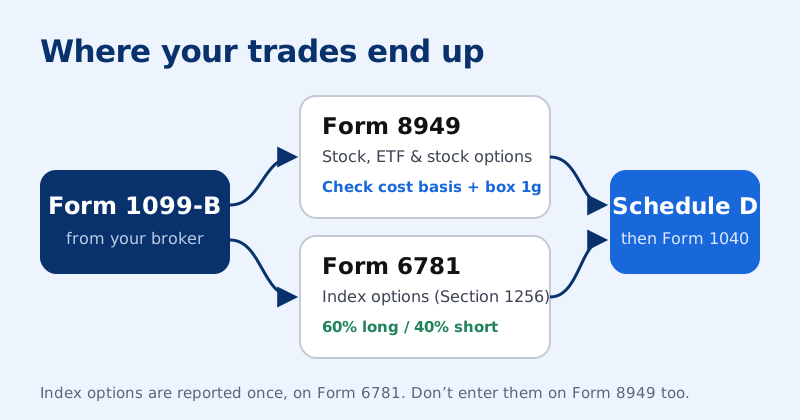
- They show up in their own Section 1256 part of your 1099-B (it may say “regulated futures contracts”), not with your stock trades. They’re reported on Form 6781, and that’s the form that applies the 60/40 split.
What I check: open your 1099-B and look for that Section 1256 part. If you traded any index options, make sure those numbers go on Form 6781 and not in with your normal short-term trades.
Mistake 2: Getting hit by the wash sale rule on options
If you trade, you need to know this one. I have a separate video on it, but here’s the short version.
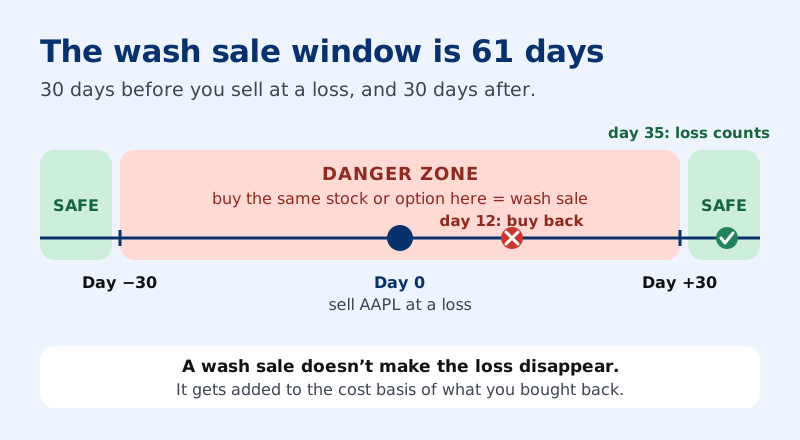
Let’s say you sell your Apple shares at a loss. Call that day zero. If you buy Apple back within 30 days, the IRS won’t let you claim that loss this year. That’s a wash sale.
What a lot of people miss is that the window goes both ways. It’s 30 days before the sale and 30 days after, so 61 days in total. Buying more Apple a week before you sell your losing shares can trigger it too.
A few things that trip up options traders:
- Options count. Selling Apple shares at a loss and then buying an Apple call within the window can be a wash sale. So can closing an option for a loss and opening the same option again.
- It has to be the same thing, or “substantially identical”. A different company doesn’t count, and neither does an ETF like QQQ that happens to hold Apple.
- After day 30 you’re in the safe zone. Buy it back then and your loss counts.
The good part is that the loss isn’t gone. It gets added to the cost basis of what you bought back, so you get it back when you sell that position later. The one case where you can lose it for good is if you buy back inside an IRA.
The trap I see the most is in December. You sell a loser to cut your tax bill, buy it back in early January because you still like the stock, and that loss you were counting on gets pushed into the next year.
What I check: on your 1099-B, look for box 1g, “Wash sale loss disallowed”. If there’s a number there, some of your losses got deferred. Your broker only catches wash sales inside one account, so if you trade the same stock at two brokers or in your IRA, you have to keep track yourself. And if you’ve already filed, still look at which trades caused it, so you know what not to do next year.
One more point for index options here: since they’re marked to market every year, the wash sale rule generally doesn’t apply to them.
Mistake 3: Not checking Form 8949 and your 1099-B
Form 8949 is where every single trade is listed: what you sold, when you bought it, when you sold it, what you got, your cost basis, and any adjustments like wash sales. The totals then go on Schedule D.
Most tax software fills it in for you when you import your 1099, so it’s easy to just click through. I’d go through it properly:
- Cost basis. Some trades come marked “basis not reported to the IRS”. If you leave the basis empty, the IRS sees the whole sale as profit.
- Expired options. An option that expired worthless still goes on the form. It’s a loss if you bought it, a gain if you sold it.
- All your accounts. If you trade at more than one broker, every 1099 goes in, including the corrected ones. Brokers often send those out in February or March.
- No double counting. Index options go on Form 6781. Make sure they’re not on Form 8949 as well.
What about assignment and early exercise?
If you sell cash-secured puts or covered calls like I do with the wheel strategy, this one is worth knowing. When an option you sold gets assigned, the premium isn’t taxed on its own. It gets folded into the stock trade instead.
- Put assigned: you buy the shares, and the premium you collected lowers your cost basis. Say you sold a $50 put for $2. Your cost basis on the shares is $48.
- Call assigned: you sell the shares, and the premium gets added to your sale price. That counts toward the gain on the shares.
The holding period of the shares is what matters then, not the option. So check these trades on your 1099-B as well, because the cost basis there should already include the premium.
My checklist before filing
1. Section 1256: did I trade any index options?
Look for the Section 1256 part of the 1099-B. SPX, XSP, NDX, RUT and VIX options go on Form 6781 with the 60/40 split.2. Wash sales: is there anything in box 1g?
Note which trades caused it so you don't repeat it next year, and keep track of the same stock across your other accounts yourself.3. Form 8949: is every trade there with the right cost basis?
Fill in any missing cost basis, include every broker and any corrected 1099s, and check that expired options are listed.If you’re new to all this, my video on how to read Form 1099 goes through the form line by line. And if you file on your own like I do, I’ve found FreeTaxUSA pretty easy to use (not sponsored).
Honestly, the thing that makes tax time easiest is keeping a proper record of your trades through the year: every open, close and roll. That’s actually why I built OptionsVault. If you have questions, drop them in the comments on the video and I’ll answer.
FAQ
How are options taxed?
Options are taxed as capital gains when you close them or they expire. Options on stocks and ETFs held for a year or less are short-term gains, taxed at your ordinary income rate. Broad-based index options like SPX are Section 1256 contracts and are taxed 60% long-term and 40% short-term no matter how long you held them.Do I pay taxes on options that expire worthless?
If you bought the option, it is a capital loss on the expiration date. If you sold it, the whole premium you collected is a short-term gain. Either way it should show up on Form 8949.Are SPY options taxed 60/40 like SPX?
No. SPY and QQQ are ETFs, so their options are taxed like stock options, as short-term or long-term capital gains depending on how long you held them. The 60/40 treatment applies to broad-based index options such as SPX, XSP, NDX and RUT, which are Section 1256 contracts.Does the wash sale rule apply to options?
Yes. Buying a call on a stock, or a substantially identical option, within 30 days of selling that stock at a loss can trigger a wash sale. Section 1256 contracts are the exception, because they are marked to market at the end of every year.Is a loss disallowed by the wash sale rule gone for good?
Usually not. The disallowed loss is added to the cost basis of the replacement position, so you get the benefit when you finally sell it. The exception is buying the replacement in an IRA, where the loss can be lost permanently.Where do I report index options on my tax return?
Your broker reports them in the Section 1256 (regulated futures contracts) part of Form 1099-B. They go on Form 6781, which applies the 60/40 split, and the totals flow to Schedule D.Check your understanding
Written by Abhi
I'm Abhi. I've invested in US stocks for years, and for the last five to six years options have been at the heart of how I trade. I started AD Finance to break complex options concepts into plain-English guides, so you can trade with confidence, and I built OptionsVault to track my own trades.
This guide is for education only and is not financial advice. Options trading involves risk. Read the full disclaimer.