Key takeaways
- Robinhood sends one consolidated 1099 PDF with your dividends, sales, Section 1256 contracts and crypto.
- Find it under Account, then Tax center (or Tax documents), sorted by year.
- The 1099-B gains and losses section is the one that decides what you owe. Spend most of your time there.
- Check the wash sale column. A number there means part of a loss was pushed into a later trade.
Before you start: read 3 Tax Mistakes to Avoid first.
Tax season is here, and that Robinhood 1099 just landed in your inbox. You open it and it’s pages and pages of numbers. Don’t worry. Most of it is detail, and only a couple of sections really matter.
In this guide I’ll break the Robinhood 1099 down into simple pieces: where to find it, what each section means, and the things I always check before I file. Whether you trade stocks, options or crypto on Robinhood, this will make sense of what you’re looking at.
I’m not a tax professional. I’ve done my own tax returns for a long time, so this is how I read the form. For your own situation, check with a tax pro.
Where to find your Robinhood 1099
Go to Account, then the Tax center (it may say tax documents). Your forms are sorted by year, most recent at the top. Tap the year and download the PDF.
Robinhood also emails you when it’s ready. It’s usually in mid-February, and the page shows the expected dates for each form. The filing deadline is normally April 15, so you have a couple of months.
It’s one consolidated form
Robinhood doesn’t send you a stack of separate forms. It sends one consolidated 1099 PDF that combines everything from your investing account:
- 1099-DIV: dividends
- 1099-INT: interest, for example on uninvested cash
- 1099-MISC: other income, like referral rewards
- 1099-B: everything you sold, stocks and options, including Section 1256 contracts
- 1099-DA: crypto sales (newer, more on it below)
Retirement accounts (IRAs) are separate and get a 1099-R. This guide sticks to your regular individual account.
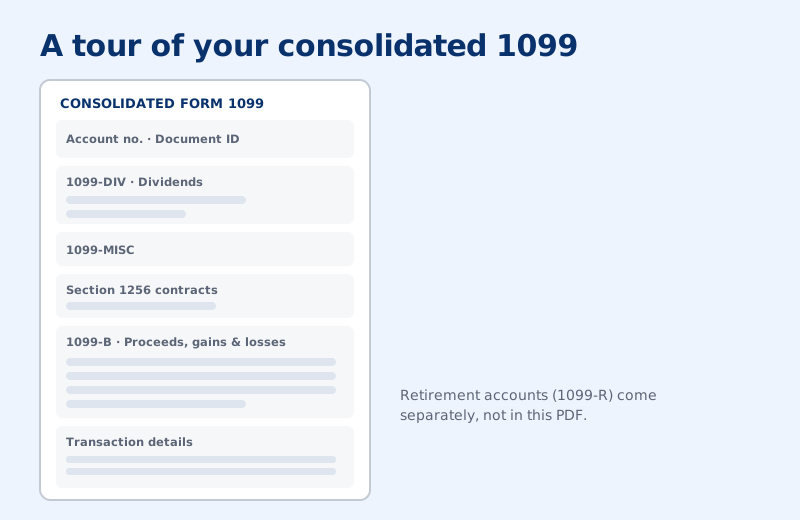
Tour the form, section by section
Tap through each section. Your numbers will be different, but the sections always look the same because they follow the IRS format:
Account details
Your name, account number and document ID. Pretty straightforward, but keep it handy: tax software asks for the account number and document ID when you import your 1099 directly from Robinhood.
Dividends and distributions (1099-DIV)
Any dividends from stocks or ETFs you held, monthly or quarterly. Qualified dividends are taxed at the lower long-term rates. And yes, dividends are taxable even if you reinvested them.
Miscellaneous (1099-MISC)
Other income, like referral or promotional stock. For most people this section is empty or very small, so you can usually skim past it.
Section 1256 contracts
Futures, broad index options like SPX, and event contracts. These get special 60/40 tax treatment and go on Form 6781. If you only traded stocks and normal stock options, this will be empty. I explain the 60/40 rule in my options taxes guide.
The big one: proceeds, gains and losses (1099-B)
This is the section that decides what you owe, so spend your time here. It's split into short-term (held a year or less, taxed like income) and long-term (held more than a year, lower rates). For each you'll see proceeds (what you sold for), cost basis (what you paid) and the gain or loss.
Look at the grand total. Positive means a capital gain you'll pay tax on. Negative means a loss, and up to $3,000 of it can offset your other income.
Wash sale loss disallowed
If you sold something at a loss and bought the same thing, or something substantially identical, within 30 days before or after, that loss shows up here. You can't claim it this year. It's added to the cost of what you bought back instead. If this column isn't zero, check which trades caused it.
Transaction details
The long pages at the end list every single sale: dates, what it was (for options, the strike, expiration and call or put), proceeds and cost. If you trade options a lot, there will be many pages. Match a few against your own records to make sure nothing looks off.
How the gains and losses add up
Here’s the math behind that main section. On each line, your gain or loss is the proceeds minus the cost basis, adjusted for any wash sale:
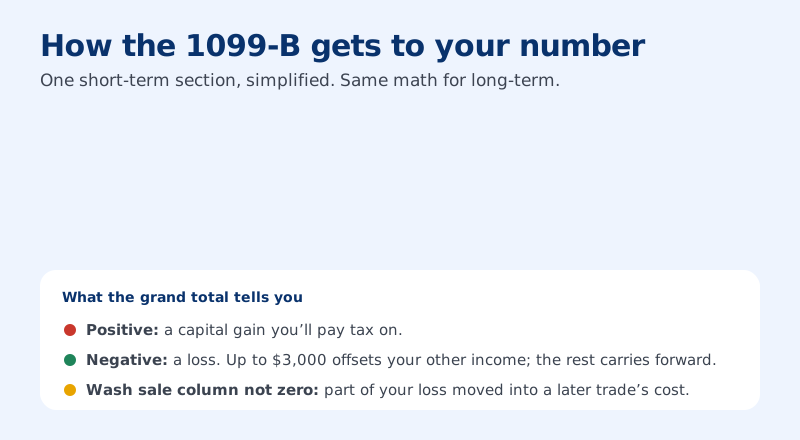
Short-term gains and losses are netted together first, then long-term. If one side has a leftover loss, it offsets the other. Whatever is left is the number that goes on your return.
If you traded crypto: Form 1099-DA
Crypto sales now come on a new form, the 1099-DA, included in the same consolidated PDF. The important thing to know: for the 2025 tax year, only the gross proceeds of crypto sales were reported to the IRS, not your cost basis. That means you had to make sure your own cost was filled in correctly, or it could look like the whole sale was profit.
Cost basis reporting for crypto starts phasing in for coins bought from 2026 onwards. Until all your holdings are covered, keep your own record of what you paid, and check Robinhood’s tax pages for the details for your year.
My checklist before I file
Before I file with my Robinhood 1099
You're ready to file. Nice and clean.
If any number looks absurd, something you’re sure is wrong, contact Robinhood before you file. This form goes to the IRS too, so it’s worth getting right. Robinhood sometimes issues corrected 1099s, so check you have the latest version.
And the thing that makes tax time easiest? Keeping your own record of trades through the year, every open, close and roll. If you have questions about a number on your form, put them in the comments on the video and I’ll help where I can.
FAQ
Where do I find my 1099 on Robinhood?
In the app or on the web, go to Account and open the Tax center (tax documents), which lists your forms by year. Download the consolidated 1099 PDF. Robinhood also emails you when it's ready, usually in mid-February.What is a consolidated 1099 from Robinhood?
It's one PDF that combines several forms, such as 1099-DIV for dividends, 1099-INT for interest, 1099-MISC for other income, 1099-B for sales including Section 1256 contracts, and 1099-DA for crypto. Retirement accounts get a separate 1099-R.What is Form 1099-DA on Robinhood?
It's the new IRS form for digital assets like crypto. For the 2025 tax year, brokers reported only the gross proceeds of crypto sales to the IRS, so you had to supply your own cost basis. Basis reporting starts phasing in for crypto bought from 2026, so keep your own records too.What does wash sale loss disallowed mean on my 1099-B?
It's the part of a loss you can't claim this year, because you bought the same or a substantially identical security within 30 days before or after the sale. That amount is added to the cost basis of the shares or options you bought, so you get it back when you sell them.Check your understanding
Written by Abhi
I'm Abhi. I've invested in US stocks for years, and for the last five to six years options have been at the heart of how I trade. I started AD Finance to break complex options concepts into plain-English guides, so you can trade with confidence, and I built OptionsVault to track my own trades.
This guide is for education only and is not financial advice. Options trading involves risk. Read the full disclaimer.