How to Hedge Your Portfolio with Options: Protective Puts, Covered Calls and Collars
How to hedge stocks with options. Protective puts, covered calls and collars with real numbers, how beta tells you how much to hedge, inverse ETFs, and the beginner mistakes to avoid.
Key takeaways
- A hedge is insurance. You pay a little, or give up a little upside, so a crash can't wipe you out.
- A protective put gives you the right to sell at the strike, which puts a floor under your shares.
- A collar pairs a put with a covered call, so the call premium pays for most of the protection.
- Don't over-hedge, don't buy short-dated puts, and know when you'll take the hedge off.
Before you start: read Trading Options 101 and Covered Call Strategy first.
Would you buy a house without insurance? No, right? So why hold a stock portfolio without any?
A lot of people only think about hedging after the market has already dropped. But the time to hedge is when things are going well and you have gains to protect. In this guide I’ll show you the hedging strategies I use and that big investors use too: covered calls, protective puts and the collar. I’ll also explain beta, so you know how much to hedge, and the mistakes beginners make.
First, understand beta
Before you hedge, you need to know how much your portfolio actually swings. That’s beta: how much a stock or portfolio moves compared with the S&P 500.
- Beta 1: moves with the market.
- Above 1: moves more. Apple is around 1.2, Tesla around 2.
- Below 1: moves less. Microsoft has been around 0.9.
Think back to 2022. The S&P 500 fell about 20%. If your portfolio was full of high-beta tech and growth stocks with a beta near 2, you could have been down 40% or more.
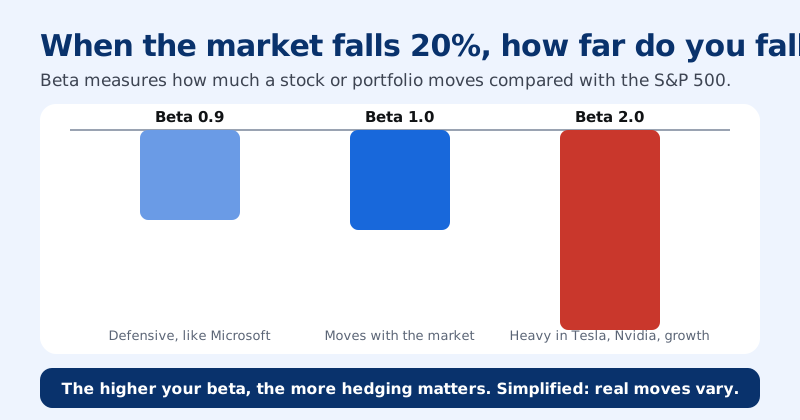
You don’t need a perfect beta. You need a balanced one. And the higher yours is, the more a hedge matters.
Strategy 1: Covered calls, income and a small hedge
If you’re up a lot in a stock, the simplest hedge is a covered call. You sell a call against your 100 shares and get paid for it.
Say you bought Nvidia at $170 and it’s now around $175. You’d be fine selling it at $180. So you sell the 180 call, about 30 days out, and collect around $700 in premium.
- Nvidia stays below $180: you keep the $700 and your shares. Your real cost drops to about $163.
- Nvidia goes above $180: your shares are sold at $180. That’s a $1,000 gain, plus the $700.
- Nvidia drops: the $700 cushions it. You’re still ahead until it falls below about $163.
Do this month after month and your cost basis keeps going down. But be clear about what it is: a small hedge. In a real crash, $700 won’t save you. For that, you need a put.
Strategy 2: Protective puts, real insurance
A protective put (sometimes called a married put) means buying a put on a stock you own. A put gives you the right to sell at the strike price, no matter how low the stock goes. That’s a floor under your shares.
Here’s a simple example. You own 100 Tesla shares at $200, so $20,000. You buy a 190 put for about $1,000. Then a COVID-style crash takes Tesla to $150.
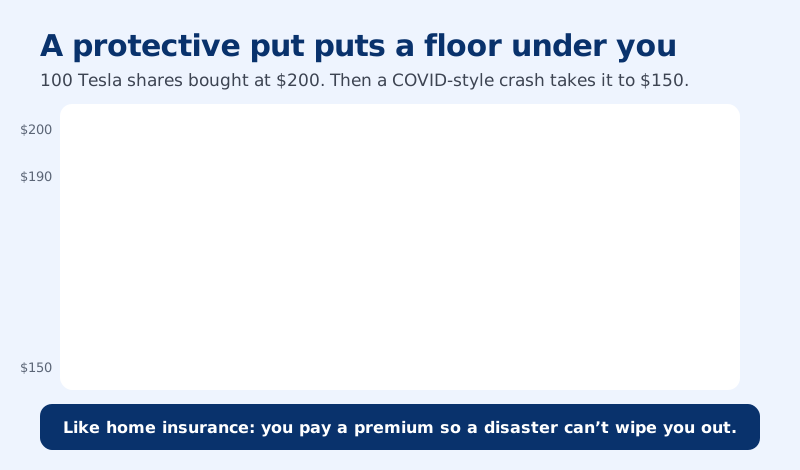
Without the put, you’re down $5,000. With it, you can sell at $190, so you only lose $1,000 on the shares, plus the $1,000 you paid for the put: $2,000 instead of $5,000.
And it’s not just a crash scenario. Compare both ways:
The crash
No hedge: −$5,000. With the 190 put: −$2,000. The put saved you $3,000. This is exactly what you paid for.
Nothing happens
No hedge: $0. With the put: −$1,000. The put expires worthless and you've lost the premium. That's the cost of insurance you didn't end up needing, like a year with no claims on your car.
Tesla rallies
No hedge: +$4,000. With the put: +$3,000. You keep all the upside, just minus the $1,000 you paid for protection.
In my video I priced a long-dated Nvidia 175 put expiring in January, about five months out, at around $1,645. Its theta was only about $5 a day. That’s why I buy puts months out: short-term puts lose value too fast. And you don’t have to hold to expiration. If the stock drops and you think it’ll recover, sell the put for a profit and buy another one later.
Hedging a whole portfolio with SPY puts
If you hold many stocks, you can hedge with puts on an index ETF like SPY instead of on each stock. The key is sizing it right:
Contracts ≈ (portfolio value × beta) ÷ (SPY price × 100)
With SPY at $450, one contract covers 100 shares, about $45,000. So a $50,000 portfolio with a beta of 1 needs about one put. With a beta of 1.5, about two. Buying ten or eleven contracts for a $50,000 portfolio is over-hedging. It pays off hugely in a crash, but if the market goes up, you’ve burned thousands on insurance you didn’t need.
Strategy 3: The collar, the Wall Street favourite
Puts cost money. Covered calls pay you money. Put them together and you get a collar: you own the stock, buy a protective put, and sell a covered call. The call premium pays for most, or all, of the put.
Example: you own 100 QQQ shares at $380. You buy the 370 put for $12 ($1,200) and sell the 395 call for $11 ($1,100). Your protection now costs just $100.
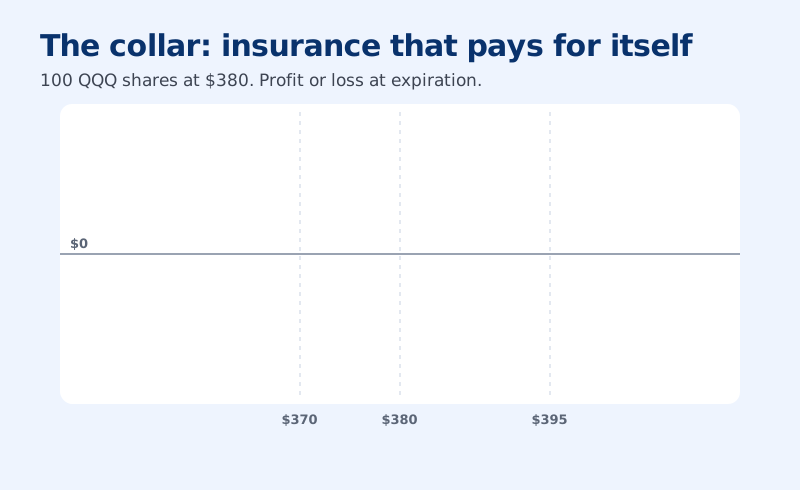
- Max loss: $380 − $370 = $10 a share, plus the $100 net cost: $1,100.
- Max gain: $395 − $380 = $15 a share, minus the $100: $1,400.
So for $100, a $38,000 position can’t lose more than $1,100. The trade-off is that you’ve capped your upside at $395. That’s how a lot of institutions protect large positions.
What about inverse ETFs?
Some people hedge with inverse ETFs, funds that go up when the market goes down: SPXU for the S&P 500, SQQQ for the Nasdaq 100, SOXS for semiconductors.
They work for a short-term hedge, but I personally don’t use them often. Most of them are leveraged and reset every day, so when the market goes up or chops sideways, they keep losing value. Over time they can head toward zero and do reverse splits. Use them for days or weeks, never as a long-term holding.
Mistakes to avoid when hedging
Before you put on a hedge
That's a proper hedge. Now a bad week can't wreck your year.
The biggest one is the exit plan. If you bought puts and the market drops, don’t get greedy waiting for more. Close the hedge, take the profit, and see how the market reacts before your next move.
If you’d rather profit from a falling market than just protect against it, look at the call credit spread. And if you have questions about hedging your own portfolio, put them in the comments on the videos. I reply to all of them.
FAQ
What is the best way to hedge a stock with options?
For most people, a protective put or a collar. A protective put gives you the right to sell at the strike, so it caps your loss for the price of the put. A collar adds a covered call, whose premium pays for most of the put, in exchange for capping your upside.How many put contracts do I need to hedge my portfolio?
Roughly your portfolio value times its beta, divided by the index price times 100. A $50,000 portfolio with a beta of 1 needs about one SPY put with SPY at $450, because each contract covers 100 shares, about $45,000. A higher-beta portfolio needs proportionally more.Is a covered call a hedge?
A partial one. The premium cushions a small drop and lowers your cost basis, but it doesn't protect you in a big crash. It's best for income and mild protection, while a put is what protects against a large drop.Should I use inverse ETFs to hedge?
Only short term. Inverse ETFs like SPXU or SQQQ rise when the market falls, but most are leveraged and reset daily, so they lose value over time when the market goes up or chops around. They aren't something to hold for months.Check your understanding
Written by Abhi
I'm Abhi. I've invested in US stocks for years, and for the last five to six years options have been at the heart of how I trade. I started AD Finance to break complex options concepts into plain-English guides, so you can trade with confidence, and I built OptionsVault to track my own trades.
This guide is for education only and is not financial advice. Options trading involves risk. Read the full disclaimer.