Bear Call Spread (Call Credit Spread) on Robinhood, Step by Step
How a bear call spread works, how to pick the strike at resistance, and how to open and close a call credit spread on Robinhood, with real Tesla, AMD and Nvidia trades.
- Outlook
- Neutral to bearish
- Legs
- Sell a call + buy a higher call
- Max profit
- The credit received
- Max loss
- Strike width − credit
- Capital
- Strike width × 100
Key takeaways
- A bear call spread sells a call and buys a higher call for protection. You collect a credit up front.
- You keep the full credit if the stock stays below your short strike at expiration.
- Pick the short strike at a strong resistance level, where the stock keeps failing.
- Your max loss is fixed: the width of the strikes minus the credit, times 100.
Before you start: read Closing a Put Credit Spread and Options Trading Terminology first.
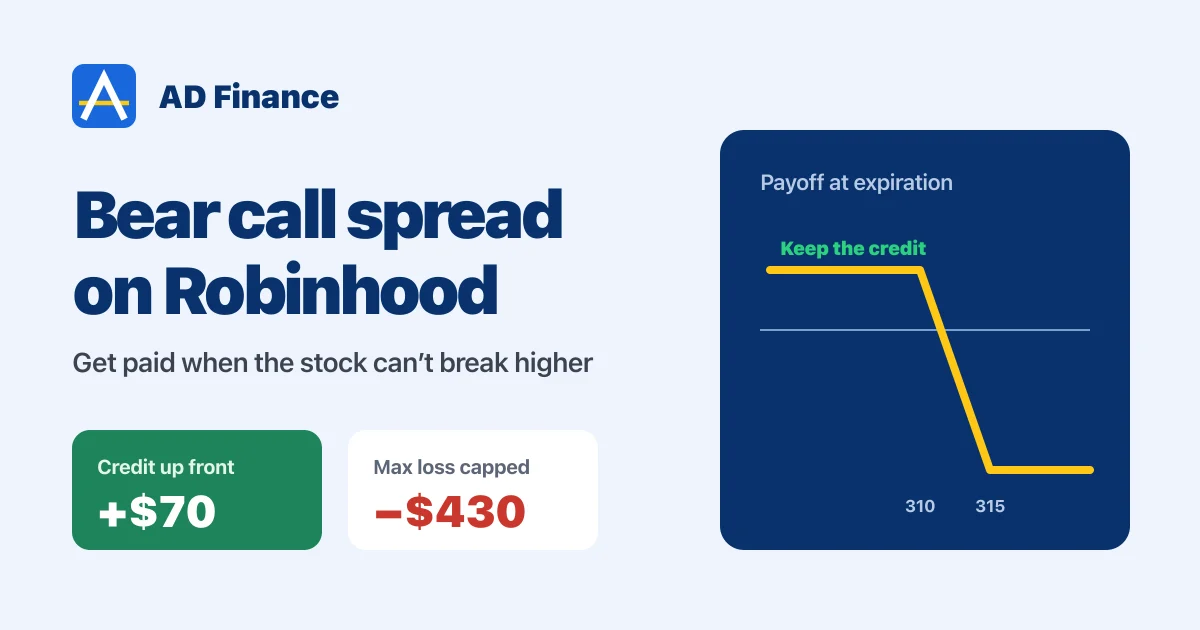
When the market loses its momentum, a lot of the usual strategies stop working. Buying calls bleeds money, and you don’t want to sell puts into a falling market. This is where the bear call spread shines.
It needs very little capital, your risk is capped, and you get paid up front. You make money if the stock goes down, goes sideways, or even goes up a little. In this guide I’ll explain how it works, how I pick the strike, and how to open and close one on Robinhood with real trades.
What is a bear call spread?
A bear call spread, also called a call credit spread, is two legs on the same stock and expiration:
- Sell a call at a strike above the current price. This is where your premium comes from.
- Buy a call a strike or two higher. This is your protection. It caps how much you can lose.
The call you sell is worth more than the one you buy, so you receive a net credit right away. As long as the stock stays below your short strike at expiration, both calls expire worthless and you keep the whole credit. It’s the mirror image of the put credit spread.
Here’s my Tesla trade from the video: sell the 310 call, buy the 315 call, for a $70 credit.
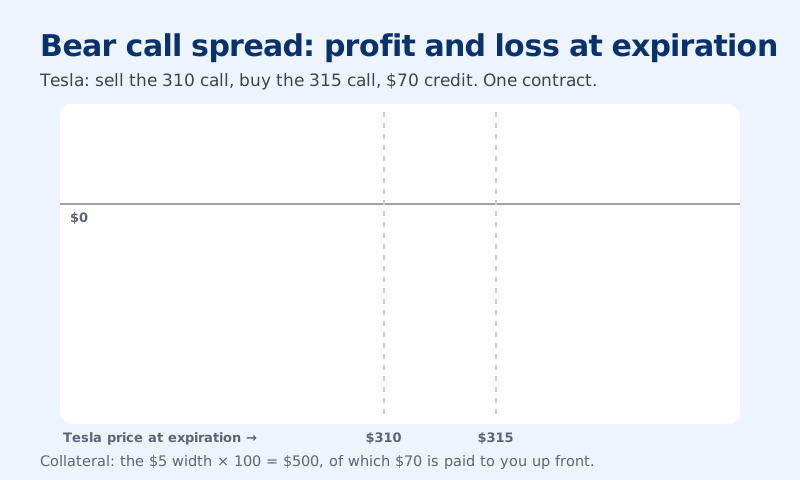
The numbers are simple:
- Max profit: the credit, $70.
- Max loss: the width of the strikes minus the credit. ($5 − $0.70) × 100 = $430.
- Break-even: the short strike plus the credit, $310.70.
- Collateral: the width × 100, so $500, and $70 of that is paid to you up front.
Where does Tesla finish? Check your result
Tap a price to see what happens at expiration:
Tesla closes at $300
+$70, the max profit. Both calls expire worthless and you keep the whole credit. This works whether Tesla fell, went sideways or rose a little, as long as it's under $310.
Tesla closes at $310.70
$0, break-even. The 310 call is worth $0.70, exactly the credit you collected. In practice I'd close well before it gets this close.
Tesla closes at $313
−$230. The 310 call is $3 in the money and the 315 call is worthless: ($3 − $0.70) × 100. Between the strikes, your loss grows dollar for dollar.
Tesla closes at $330
−$430, the max loss. Above $315, your long call kicks in and the loss stops growing. Whether Tesla ends at $320 or $400, you can't lose more than $430 per contract.
How I pick the strike: resistance
This is the most important part. If you get the strike wrong, the strategy goes against you.
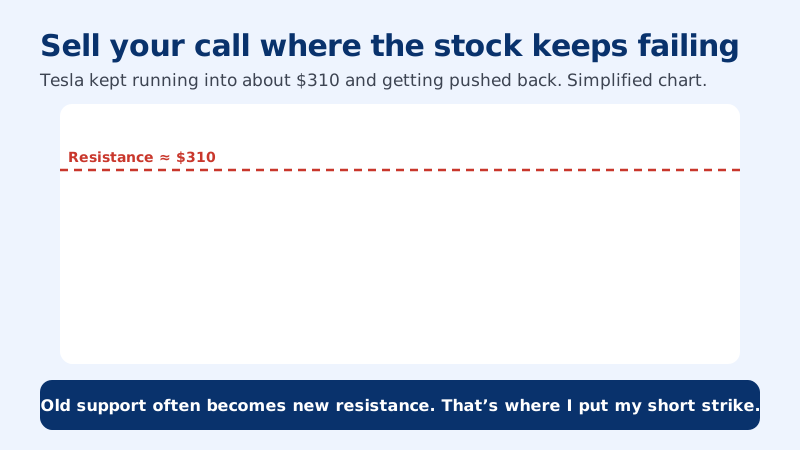
I look for a level where the stock keeps trying to break higher and keeps failing: a strong resistance on the daily chart over the last year. Then I sell my call at or above that level.
With Tesla, it had run close to $500 and then come all the way down. On the way back up, it kept getting stuck below about $310. Old support had turned into new resistance. So that’s where I sold.
For the expiration, I like 30 to 45 days out. That’s where time decay starts to really speed up, and you still collect a decent premium. For Tesla I went out to the June expiration.
How to open a bear call spread on Robinhood
Spreads need Level 3 options approval on Robinhood. Then:
Step 1 of 5
Open the options chain and pick the expiration
Go to the stock, tap Trade, then Trade Options. Pick an expiration around 30 to 45 days out.
Step 2 of 5
Sell the call at your resistance strike
Select Sell and Call, and tap the strike at or above resistance. In my AMD example from 2023, I didn't think AMD would get past $108 in a month, so I sold the 108 call.
Step 3 of 5
Buy the call one strike above
Now select Buy and Call, and tap the next strike up, the 109 in my AMD example. Robinhood recognises it as a call credit spread.
Step 4 of 5
Check the profit and loss chart
Robinhood shows you the max profit, max loss and break-even. On my AMD trade, the credit was about $27 on $100 of collateral, so the max loss was $73. That's a nice size for a small account.
Step 5 of 5
Set the limit price and submit
Since you're collecting a credit, a price closer to the bid fills faster. The middle of the bid and ask usually fills too, with a bit of patience. On Tesla I set $0.70, the middle. Review the two legs, sell to open and buy to open, and submit.
If you have more capital, you can scale up the number of contracts. Five Tesla contracts would be $350 of credit, with $2,500 of collateral. That’s still far less than shorting the stock.
How to close a call credit spread on Robinhood
I opened an Nvidia 510/515 call credit spread for a $106 credit. With a week still to go, I was already up about 25%: buying it back would cost around $80. There are two ways to close it:
The easy way
Open the position and tap Close. Enter the number of contracts and a limit price. Since you're paying to close, go closer to the ask, or it may not fill. Here, about $80. You collected $106 and paid $80, so you keep $26.
The manual way, same result
Go to the chain for that expiration and do the reverse of what you opened: buy the 510 call and sell the 515 call. Robinhood shows both legs, buy to close and sell to close. It costs exactly the same as the Close button, but you can see clearly what's happening.
Advanced: close only the short call
If you're suddenly bullish, you can buy back just the 510 call and keep the 515 call open. Your collateral is released, and if Nvidia shoots up, that long call can make money. Only do this if you're really confident. Otherwise, time decay eats the long call.
Before you open a bear call spread
My bear call spread checklist
You're ready. Start with one contract.
Put a bear call spread together with a put credit spread on the same stock, and you get an iron condor, which profits when the stock stays in a range. If you have questions about your own spread, put them in the comments on the videos. I reply to all of them.
FAQ
What is a bear call spread?
A bear call spread, also called a call credit spread, means selling a call at one strike and buying a call at a higher strike with the same expiration. You receive a net credit, and you keep it all if the stock stays below the short strike at expiration.What is the max loss on a bear call spread?
The width between the two strikes minus the credit you received, times 100. A 310/315 spread opened for a $0.70 credit has a max loss of ($5 − $0.70) × 100 = $430.How do I close a call credit spread on Robinhood?
Open the position and tap Close, enter the number of contracts and a limit price, then submit. For a faster fill, set the price closer to the ask. You can also close the legs yourself by buying back the short call and selling the long call.Do I need Level 3 options for a bear call spread on Robinhood?
Yes. Spreads, including the bear call spread, need Level 3 options approval on Robinhood, which also requires a margin account.Check your understanding
Written by Abhi
I'm Abhi. I've invested in US stocks for years, and for the last five to six years options have been at the heart of how I trade. I started AD Finance to break complex options concepts into plain-English guides, so you can trade with confidence, and I built OptionsVault to track my own trades.
This guide is for education only and is not financial advice. Options trading involves risk. Read the full disclaimer.