LEAPS Options for Beginners: What They Are and How to Buy Them on Robinhood
What LEAPS options are, why they cost a fraction of 100 shares, how to pick the strike and expiration, how to buy them on Robinhood step by step, and the risks to know first.
- Outlook
- Bullish, over months
- Legs
- 1 long call, about a year out
- Max profit
- Unlimited as the stock rises
- Max loss
- The premium you paid
- Capital
- Often 25–35% of 100 shares
Key takeaways
- LEAPS are just call (or put) options with a long expiration, usually a year or more.
- A deep in-the-money LEAPS call moves a lot like 100 shares for about a third of the cash.
- Pick a strike around 0.80–0.90 delta. Cheaper at-the-money LEAPS are mostly time value.
- Keep LEAPS to about 5–10% of your portfolio, and use them when the market is in an uptrend.
Before you start: read Top 5 Bullish Options Strategies and The Complete Delta 101 Guide first.

Today I want to break down LEAPS options: what they are, why they matter, and how you can use them as a beginner to get more out of your investing. I’ll keep it simple and practical, and at the end I’ll show you exactly how to buy one on Robinhood, using real trades from my account.
What are LEAPS options?
LEAPS stands for Long-term Equity AnticiPation Securities. I know, that’s a big term. Just ignore it.
In plain English, LEAPS are regular option contracts with a long expiration, usually a year or more out. That’s it. If you know how to buy a call, you already know how to buy a LEAPS. You just pick an expiration date far in the future.
You can buy LEAPS calls if you think a stock will go up over the next year or two. You can also buy LEAPS puts if you think it’ll go down, or as insurance for stocks you own.
Why I use LEAPS
1. You need a lot less capital
Options always cover 100 shares. Say Apple is around $180. Buying 100 shares costs you $18,000.
When I showed this on Robinhood, a deep in-the-money LEAPS call at the 130 strike, a year out, cost about $6,000. That’s roughly a third of the price, and it still moves about $90 for every $1 Apple moves, because its delta was around 0.90.
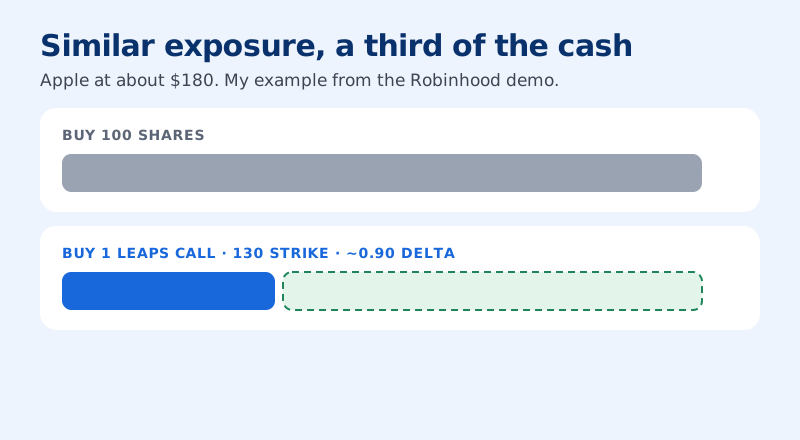
That’s the leverage. The other $12,000 can sit in cash or go into something else.
2. Time is on your side
With a year or more until expiration, you can ride out the short-term ups and downs and even a few earnings cycles. If the stock really takes off, you capture that whole move, because there’s no cap on the upside of a call.
3. Much less time decay
This is the big one. Every option loses a bit of value each day from time decay (theta), and short-term options lose it fastest. A LEAPS loses it much more slowly.
Here’s a real comparison from my Palantir trades. Same 140 strike, two different expirations:
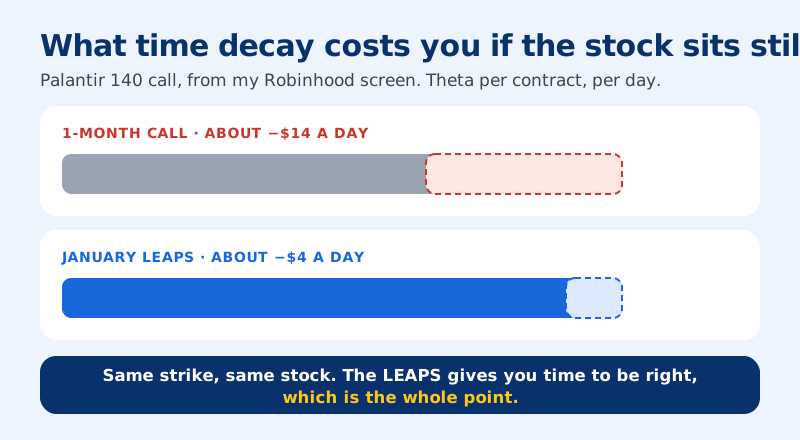
If the stock doesn’t move, the short-term call bleeds you every single day. The LEAPS gives you time to be right.
Shares vs LEAPS: what happens when the stock moves?
Let’s be honest about both sides. Using my Apple example, 100 shares at $180 ($18,000) against one 130-strike LEAPS bought for $6,000, here’s where you’d be at expiration. Tap a scenario:
Apple goes from $180 to $216
100 shares: +$3,600, which is +20% on $18,000.
LEAPS: worth $216 − $130 = $86, so $8,600. That's +$2,600, or +43% on $6,000.
Less profit in dollars, but more than double the return on the money you put in. That's the leverage working for you.
Apple stays at $180
100 shares: $0. Nothing gained, nothing lost.
LEAPS: worth $180 − $130 = $50, so $5,000. That's −$1,000 (−17%). You paid $10 a share of time value, and with the stock flat, it's gone.
This is the cost of renting instead of owning.
Apple drops from $180 to $144
100 shares: −$3,600, or −20%.
LEAPS: worth $144 − $130 = $14, so $1,400. That's −$4,600 (−77%).
The dollar loss is similar, but on a much smaller amount, so the percentage hit is huge. This is why you never put too much into LEAPS.
Apple drops from $180 to $126
100 shares: −$5,400, or −30%. You still own Apple and can wait.
LEAPS: below the 130 strike, so it expires worthless: −$6,000 (−100%).
Your loss is capped at what you paid, but you can lose all of it. With shares you can wait forever. With LEAPS, the clock always runs out.
Numbers are at expiration and ignore dividends, so they’re a simplification, but they show the real trade-off.
How to pick the expiration and strike
Expiration: technically a LEAPS is a year or more out. The longer you go, the more it costs, but the safer it is. For my shorter swing trades I sometimes go around six months to a January expiry, which is still long enough that time decay stays low.
Strike: look at delta. Robinhood shows it for every strike on the chain. Traditionally people go for about 0.90 delta, which behaves almost exactly like owning the stock, but costs more. I’m fine with around 0.80. Below that, you’re buying mostly time value.
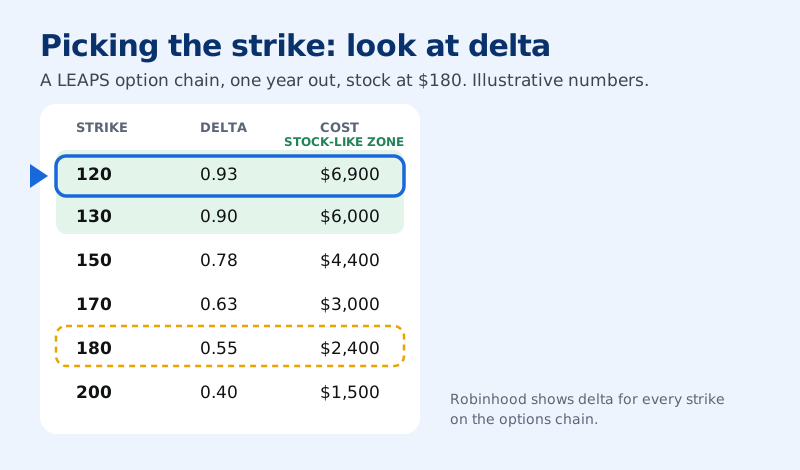
If delta is new to you, read my delta guide first. It’ll make this click.
How to buy LEAPS on Robinhood, step by step
Step 1 of 5
Open the options chain
Search for the stock, tap Trade, then Trade Options. Make sure Buy and Call are selected.
Step 2 of 5
Pick an expiration far out
Scroll the expiration dates and pick one a year or more away. January expirations usually have the most choice. This one step is what turns a normal call into a LEAPS.
Step 3 of 5
Pick a strike around 0.80–0.90 delta
Scroll down the strikes and check the delta on each. In my Apple example, the 135 strike showed 0.88 and the 130 strike was close to 0.90, so I picked the 130. Robinhood shows the profit and loss chart, and you'll see the max profit is unlimited.
Step 4 of 5
Set a limit price
Enter how many contracts you want and a limit price. Since you're buying, the ask gets you filled fastest. If you're patient, try something between the bid and the ask. On LEAPS the spread can be wide, so it's worth a little patience.
Step 5 of 5
Review and submit
Check the expiration, strike and total cost one more time, then submit. Done. That's your LEAPS.
And remember, you don't have to hold it until expiration. You can sell it any time the stock hits your target.
My Palantir LEAPS trades
Here’s how I actually used LEAPS in mid-2025. Palantir had hit an all-time high and was consolidating inside its Bollinger Bands, while the overall market was in a bullish trend.
On June 27, 2025 I bought a Palantir 140 call expiring the next January, with Palantir around $134, for about $2,585. Palantir moved and I sold it the same day for about $2,685. Around $100 in a few minutes.
Then on a sudden dip I bought the same contract again, added one more lower to average down, and sold both for about $5,200. Over that week, these quick LEAPS swing trades made me more than $500.
Buying 100 shares of Palantir would have cost me over $13,000. For the same money I could hold four or five LEAPS contracts instead. That’s the leverage. But it cuts both ways, which is why I size these small. And on the shares I do own, I keep selling covered calls, which is still my bread and butter.
The risks of LEAPS
If LEAPS are so good, why doesn’t everyone buy them? A few reasons:
- You don’t own anything. It’s a contract. If the stock is below your strike at expiration, you lose everything you paid.
- You’re racing the clock. With shares you can wait forever. With LEAPS, time decay is small but it never stops.
- Leverage works both ways. A 20% drop in the stock can be a 70–80% drop in your LEAPS, as you saw above.
- Timing matters. LEAPS work best when the market is making higher highs. In a bear market you’re losing money every day while you wait for a recovery that might take longer than your expiration.
That’s why I keep LEAPS to about 5–10% of my portfolio, spread across a few stocks in different sectors.
LEAPS also have a second life as the long leg of a poor man’s covered call, where you sell short-term calls against your LEAPS for income. Once you’re comfortable buying LEAPS, that’s the natural next step. Read the PMCC risks guide first.
Before you buy your first LEAPS
My LEAPS checklist
Good to go. Start with one contract.
If you have questions about LEAPS or any other options strategy, put them in the comments on the video. I read all of them and reply.
FAQ
What are LEAPS options?
LEAPS (Long-term Equity AnticiPation Securities) are regular options with a long expiration, usually a year or more out. A LEAPS call gives you the right to buy 100 shares at the strike price until it expires, so it can stand in for owning the stock with much less money.How do I buy LEAPS on Robinhood?
Open the stock, tap Trade and then Trade Options. Choose Buy and Call, pick an expiration a year or more away, and choose a strike around 0.80 to 0.90 delta. Set a limit price, then review and submit.What delta should I use for LEAPS?
Most people buying LEAPS as a stock replacement use about 0.80 to 0.90 delta. Those deep in-the-money strikes move close to the stock and are mostly intrinsic value, so time decay hurts them less. Lower-delta strikes are cheaper but need a bigger move to pay off.Can you lose money on LEAPS?
Yes. If the stock is below your strike at expiration, the LEAPS call expires worthless and you lose the full premium. Even before that, a drop in the stock hits a LEAPS harder in percentage terms than it hits shares, because of the leverage.Check your understanding
Written by Abhi
I'm Abhi. I've invested in US stocks for years, and for the last five to six years options have been at the heart of how I trade. I started AD Finance to break complex options concepts into plain-English guides, so you can trade with confidence, and I built OptionsVault to track my own trades.
This guide is for education only and is not financial advice. Options trading involves risk. Read the full disclaimer.