Is PMCC Too Risky? Poor Man’s Covered Call Risks (And How to Avoid Them)
The real risks of a poor man's covered call, from the short call running past your strike to weekend gaps on the LEAPS, and how I manage them with a live Intel PMCC on Robinhood.
- Outlook
- Moderately bullish
- Legs
- Long deep ITM call + short near-term call
- Max profit
- Capped by the short strike each cycle
- Max loss
- Net debit paid
- Capital
- Cost of the long call
Key takeaways
- A PMCC has the same main risk as a covered call: the stock runs past your short strike. But you own an option, not shares.
- Pick the short strike above resistance. Look back a month for weekly calls and three months for monthly calls.
- If the stock is heading through your strike, roll out and up for a net credit before Friday instead of waiting.
- Buy the long call deep in the money and months out, so time decay and weekend gaps hurt it less.
Before you start: read Poor Man’s Covered Call and Selecting the Perfect Strike Price first.
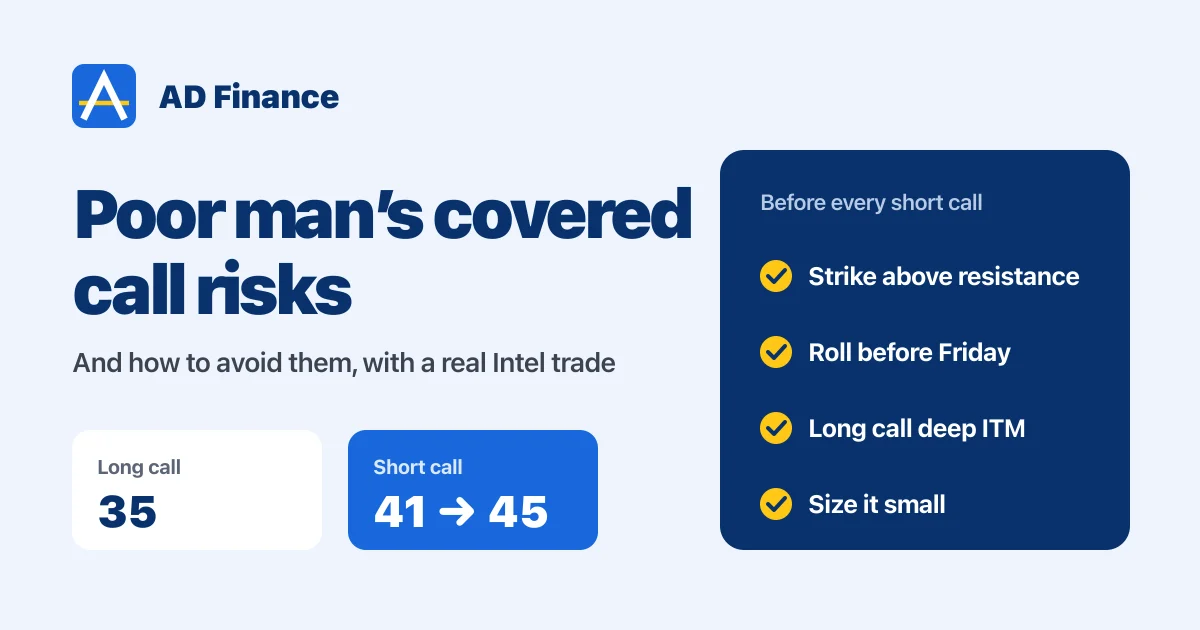
Is the poor man’s covered call too risky? It’s a question I get a lot, usually from someone whose short call has just gone in the money. The short answer: the risks are real, but they’re manageable once you know where they come from.
In this guide I’ll go through the risks of a PMCC, what I do to reduce each one, and then show you a live Intel PMCC on my Robinhood account, including how I’d roll the short call if Intel runs through my strike.
If you’ve never set up a PMCC, start with my poor man’s covered call guide. I won’t repeat every detail of opening one here.
A quick recap: PMCC vs covered call
With a traditional covered call, you own 100 shares and sell a call against them. With a poor man’s covered call, you buy a long-dated, deep in-the-money call instead of the shares. That long call moves a lot like the stock, costs a fraction of the price, and gives you the right to sell calls against it.
So you get covered-call income for much less capital. That’s where the “poor man” comes from. But the long call is a contract, not shares, and that one difference is where most PMCC risks come from.
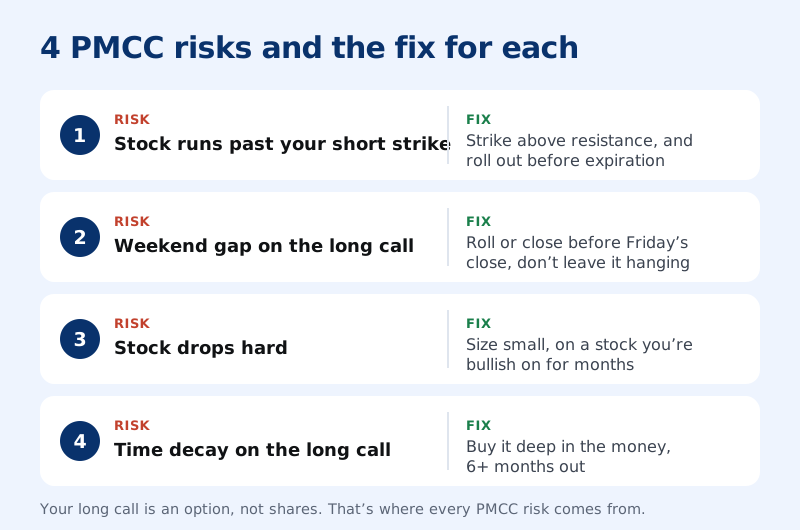
The risks of a poor man’s covered call
1. The stock runs past your short strike
This is the same number-one risk as a normal covered call. In a covered call, if the stock rises above your strike, your shares get called away. You miss the extra upside, but there’s nothing more to it.
In a PMCC you don’t have shares to give. If your short call is assigned, you end up short 100 shares and have to deal with that. And many brokers, Robinhood included, may close an in-the-money position for you near expiration if they see an assignment risk. Either way, the short call gets bought back at a loss.
Your long call should be up at that point, because the stock went up. The problem is what comes next.
2. A weekend gap on the long call
Once the short call is closed, your long call is on its own. Hold it over the weekend and you’re exposed to whatever happens before Monday’s open. If the stock gaps down, the gain on your long call shrinks, and time decay keeps eating into its extrinsic value, weekends included.
That can leave you in an awkward spot: to sell the next call, you’d have to pick a strike that locks in a loss on the whole position. With shares you could just wait. With an option, the clock is always running.
3. The stock drops hard
This one isn’t specific to rolling, but it’s the biggest risk in dollar terms. If the stock falls a lot, your long call loses value faster in percentage terms than shares would, and the small premiums from your short calls won’t make up for it. Your maximum loss is what you paid for the long call, minus the premiums you’ve collected.
4. Time decay on the long call
A long call that’s only slightly in the money, or only a few months out, has a lot of extrinsic value. Theta works against that every day. A deep in-the-money call far out in time has much less of it, which is why the long leg is usually a LEAPS call.
Two more to keep in mind, which I cover in the main guide: a short call near an ex-dividend date is more likely to be assigned early, and if your short strike is too close to your long strike, even a “good” assignment can lose money. Keep the short strike above your long strike plus what you paid for the long call.
How to reduce PMCC risks
Do your homework on resistance before picking the short strike
This is the most important thing you can do, and you do it before you open the short call. Look at where the stock has been running into resistance:
- If you sell weekly calls, look at at least the last month.
- If you sell monthly calls, look at the last three months.
- Then zoom out and check where the longer-term resistance is too.
Then make sure your short strike is above that resistance. If your strike is below it, you’re in the same situation as a traditional covered call that keeps getting tested: every time the stock pushes up, your call is in trouble.
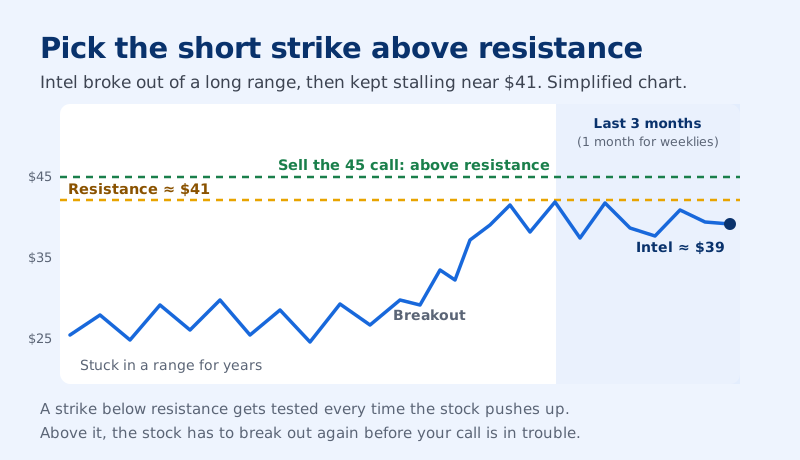
For the charting, I use Robinhood Legend rather than the regular Robinhood app. The normal app just shows a line, which isn’t great for spotting short-term and long-term resistance. Legend gives you proper candles and drawing tools. If you want a refresher on reading charts for strike selection, see my guide on selecting the perfect strike price.
Roll the short call before it’s too late
If the stock is heading through your strike anyway, don’t wait for Friday. Roll the short call: buy it back and sell a new one at a later expiration and, usually, a higher strike, in one order. It works exactly like rolling a normal covered call.
The key is to stay in credit. If the stock is far above your strike, you may need to go further out in time to collect enough premium to cover the buyback. And remember, while your short call is losing, your long call is gaining. That’s the good part about a PMCC: you’re managing the short side while the long side keeps making you money.
Buy the long call deeper in the money
If you plan to sell calls for six months or more, buy the long call deeper in the money and further out. More of its price is intrinsic value, so time decay and weekend gaps hurt it less, and it moves closer to one-for-one with the stock.
Keep it small
Start with one contract, on a stock you’re bullish on for at least the life of the long call. A PMCC needs less capital than a covered call, which makes it tempting to open too many. Don’t.
My Intel PMCC on Robinhood
Here’s a PMCC I had open when I recorded the video in November 2025, so you can see all of this on a real position.
Why Intel. Intel had been stuck in a range for years. After Nvidia’s investment in the company in September 2025, it broke out of that range. When a stock breaks out of a long range like that, there’s room for a new trend, so I opened a PMCC on it. I kept my exposure small: one contract.
The long call. I bought the Intel 35 call expiring in 2026, about nine months out. I’ll be honest, that’s not very deep in the money, and it’s shorter than I’d normally go. I did it on purpose: I’m riding the current bullish trend and plan to close it out, not hold it for a year. If you want to sell calls against it for six months or more, go deeper in the money, as I said above.
The short call. Against it I sold the 41 call expiring November 7, for an average credit of $0.97, so $97. Intel was around $39, so that position was in profit. The risk is clear: if Intel goes above $41 by Friday, the short call is in the money.
The resistance check. Looking at the three-month chart, Intel had good support below and kept running into resistance right around where my strike was. So the first fix is simple: next time, put the strike above that resistance, at 42 or even 45.
How I’d roll it
Say it’s Wednesday, November 5, and Intel is at $42. It looks like it will close above 41 on Friday. Here’s what I’d do on Robinhood:
- Open the short call position and tap Roll this position.
- Pick a later expiration. One week out works if you’re only slightly in the money. If you’re deep in the money, go further out to collect enough premium.
- Pick a higher strike. I’d go about 20 days out and choose the 45 strike, above the resistance.
- Check that the order is still a credit, not a debit. In my example it was.
- Review and submit.
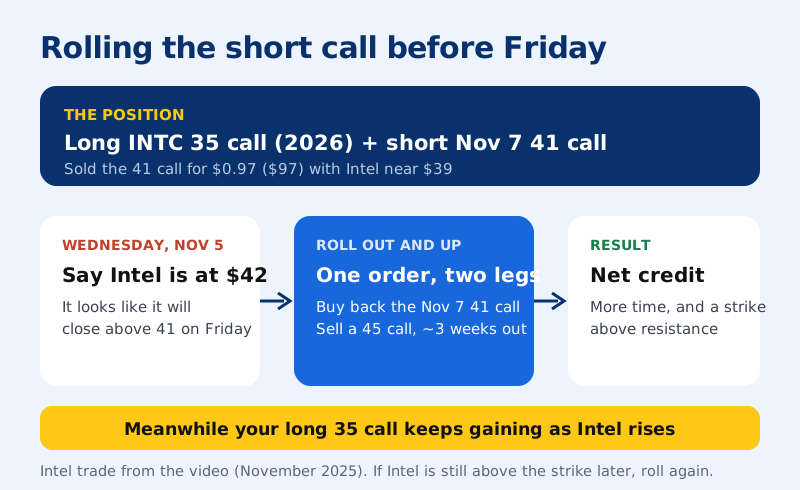
If Intel is still above your strike when the new expiration comes around, you can roll it out again. In the meantime, your long 35 call keeps gaining as Intel rises.
Wait for consolidation, then reset
No stock goes up in a straight line. It has to consolidate before its next leg up or down. My read on Intel was that it would spend the next couple of months moving sideways, somewhere between $40 and $44, after breaking out. That’s exactly what you want for selling calls. A move down is fine too, because your short call expires worthless.
So once the stock settles into a range, close the rolled call, find the new resistance point, pick a strike above it, and sell your next short call. That’s how you keep a PMCC running.
A PMCC risk checklist
Before every short call on a PMCC, I run through this:
- Strike above resistance. One month of chart for weeklies, three months for monthlies.
- Short strike above your break-even. Long strike plus what you paid for the long call.
- No surprises in the week. Earnings, ex-dividend dates, big news.
- A plan for Friday. If the stock is heading through your strike, roll by Wednesday or Thursday, not after the close.
- Long call with room. Deep in the money and far enough out for the calls you plan to sell.
Track every short call and roll so you know what the position has really made. I built OptionsVault to do exactly that for my own trades. And if you’d rather start with shares, my guide on selling covered calls on Robinhood walks through the normal version.
If you have any questions about your own PMCC, put them in the comments on the video. I reply to all of them.
FAQ
Is a poor man's covered call too risky?
It isn't riskier than a covered call if you manage it, but the risks are different. Your maximum loss is what you paid for the long call minus the premiums you've collected. The main dangers are the stock running past your short strike, gaps while you hold the long call over a weekend, and a sharp drop in the stock, which hits the long call harder than it would hit shares.What happens if the short call in a PMCC is assigned?
You have to deliver 100 shares you don't own, so you end up short the stock. You can buy the shares back, or exercise your long call to deliver them, although exercising throws away whatever time value the long call still has. Many brokers, including Robinhood, may close an in-the-money position for you near expiration instead. Rolling the short call before expiration avoids all of this.Can you roll a poor man's covered call?
Yes. You roll the short call the same way as in a normal covered call. Buy it back and sell a new one at a later expiration, usually at a higher strike, in one order. Aim for a net credit. The long call stays as it is.How deep in the money should the long call be for a PMCC?
Deep enough that most of its price is intrinsic value, often a delta around 0.80 or higher, and at least six months out if you plan to sell calls against it for a while. The deeper and longer it is, the less time decay and weekend gaps eat into it.Check your understanding
Written by Abhi
I'm Abhi. I've invested in US stocks for years, and for the last five to six years options have been at the heart of how I trade. I started AD Finance to break complex options concepts into plain-English guides, so you can trade with confidence, and I built OptionsVault to track my own trades.
This guide is for education only and is not financial advice. Options trading involves risk. Read the full disclaimer.
Taggedpmcc