Selling Weekly Puts: How I Turn Every Friday Into Payday
How I sell weekly cash-secured puts for income every Friday. Why weekly can beat monthly premium, a real SOXL trade, my results, and the risks to know first.
- Outlook
- Neutral to bullish
- Legs
- 1 short put, expiring Friday
- Max profit
- The premium
- Max loss
- Strike − premium (stock to $0)
- Capital
- Strike × 100 in cash
Key takeaways
- Selling weekly puts gives you up to four paydays a month instead of one.
- Time decay is fastest in the last week, so four weeklies can add up to more premium than one monthly.
- Weeklies leave very little time to recover from a bad move, so pick a stock you'd be fine owning.
- SOXL pays big premiums because it's a 3× leveraged ETF. That's also why it can fall much harder than the chip stocks it tracks.
Before you start: read Cash Secured Put Strategy and Option Greeks 101 first.
What if every Friday felt like payday? Not a monthly paycheck, but a small amount landing in your account every single week. That’s the idea behind selling weekly puts, and it’s how I trade a good part of my account.
I’m going to split this into three parts. First, why I like weekly options more than monthly. Second, the exact trade I sell almost every week. And at the end I’ll show you how much it made me in May 2024, straight from the sheet where I track every trade.
What I mean by a weekly paycheck
The strategy is a cash-secured put that expires on Friday. You sell one put, someone pays you a premium for it, and you keep enough cash in your account to buy 100 shares at the strike price if you have to.
If the stock is above your strike on Friday, the put expires and the premium is yours. Then you do it again the next week. If you’re new to selling puts, start with my cash-secured put guide, because I won’t go into every detail here.
Weekly vs monthly options: why I prefer weekly
I see three reasons.
1. Four paydays instead of one. With a monthly option you get paid once a month. With weeklies you get paid every Friday, so you see money coming into your account four times a month. That alone makes it feel a lot more like a paycheck.
2. More premium in total. Let me show you with QQQ, the ETF that tracks the Nasdaq 100. In May 2024, with QQQ in the mid 440s, I looked at the 440 put, which was around a support level.
- The monthly put, about a month out, paid $6.16, so $616.
- The weekly put at the same 440 strike paid about $2.00, so $200, for just one week.
If you could do that four times, that’s $800 against $616 from the monthly.
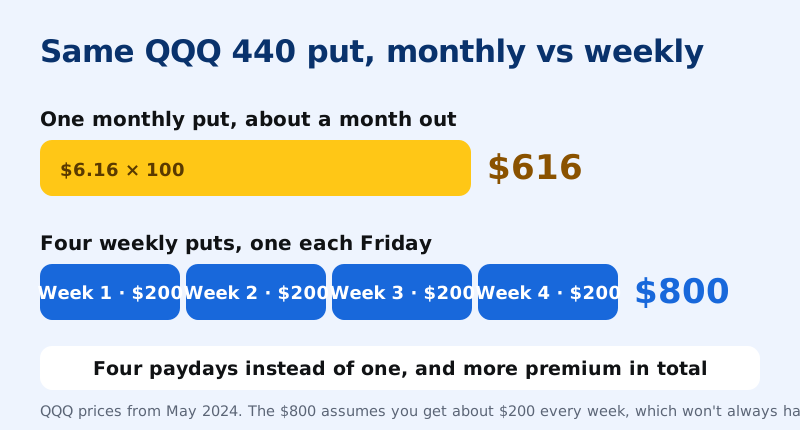
Now, that $800 is the best case. You won’t get exactly $200 every week, because the premium depends on where QQQ is and how volatile the market is. But the reason weeklies tend to pay more in total is real, and it’s theta, or time decay.
An option loses its time value slowly when expiration is far away, and much faster in the last week or so. When you sell weeklies, you’re selling only that last, fastest part of the decay, over and over.
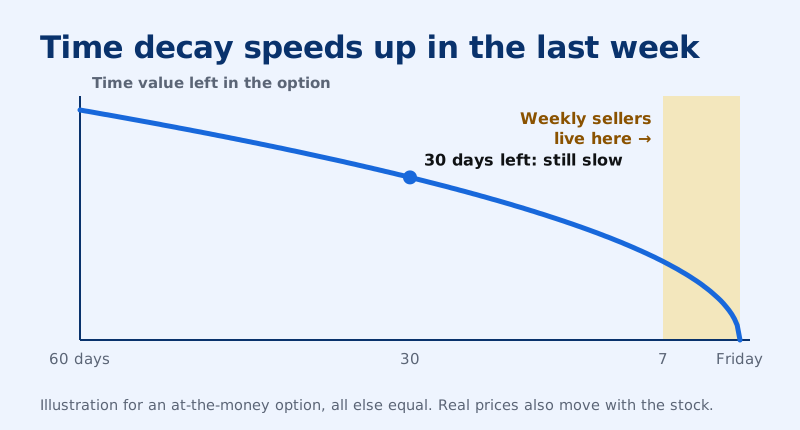
I explain theta and the other Greeks in my option Greeks guide if you want to go deeper.
3. A lot more stocks have weeklies now. Years ago, most stocks only had monthly options. Today a big list of stocks and ETFs have options expiring every Friday. Bank of America is a good example: for a long time it only had monthlies, and now it has weeklies too. A lot of dividend-type stocks are the same. So you have far more choice across different sectors than you had maybe ten years ago.
The risks of selling weekly puts
I want to be honest here, because weeklies aren’t free money.
- No time to recover. With a monthly put, if the stock drops in week one it has three weeks to come back. With a weekly, a drop on Thursday is a drop on Friday. You’re assigned or you’re rolling.
- More trades to manage. Four trades a month instead of one means four times the decisions, and four times the fees if your broker charges per contract.
- Events in the week matter more. If a big earnings report lands in your week, the stock can gap right through your strike. Always check what’s coming up before you sell.
- More premium isn’t always more profit. Cboe tracks both a monthly and a weekly put-selling index on the S&P 500. Over the years the weekly one collected more premium, but that didn’t always mean better returns, because the losing weeks hit harder.
None of this means weeklies are bad. I still prefer them. It just means you pick the stock and the strike more carefully.
The stock I sell weekly puts on: SOXL
The one I sell weekly puts on is SOXL, the Direxion Daily Semiconductor Bull 3X ETF. It follows the big chip companies, names like Nvidia, AMD and Broadcom.
The reason I like it is simple: the premiums are big. But you need to understand why they’re big. SOXL is a 3× leveraged ETF. If chip stocks fall 5% in a day, SOXL falls around 15%. And because the leverage resets every day, it can lose a lot more than three times the index over a few bad weeks. In 2022 it lost close to 90% of its value from the peak.
So the high premium is the market paying you for that risk. That’s the trade-off. I’m comfortable holding semiconductors for the long term and I size this position small. If you’re not, use something calmer like QQQ or a stock you’d happily own, and you’ll get less premium but sleep better.
The SOXL trade, step by step
Here’s the trade from my video, for the May 24, 2024 expiration:
- Go to SOXL’s option chain and choose Sell and Put. You’re selling, not buying.
- Pick the weekly expiration, the coming Friday.
- Pick the strike. I’ve been doing this for a while, and $40 was a good range based on where SOXL was trading.
- The premium showed $1.47, so $147 credited to my account.
- Make sure you have $4,000 in cash for it (the 40 strike × 100 shares), then review and submit.
My broker showed the max loss as $3,853. That’s the $4,000 minus the premium, and it only happens if SOXL goes to zero. Your break-even is $38.53, which is the strike minus the premium.
$147 on $4,000 is about 3.7% for one week. That’s a great return, but remember what I said: it’s that high because SOXL can move that much.
What happens on Friday
There are only two ways this ends.
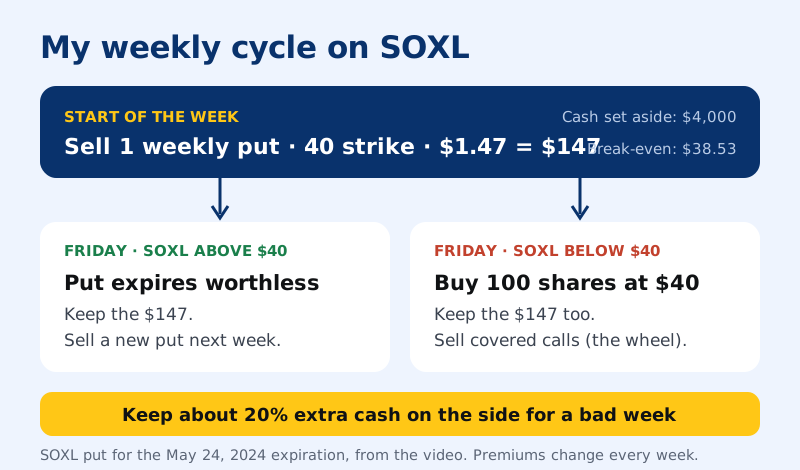
SOXL closes above $40. The put expires, you keep the $147, and you sell another put the next week. You keep repeating this for as long as it works.
SOXL closes below $40. You get assigned and buy 100 shares at $40. That’s not the end of the world, because you still keep the premium, and now you can sell covered calls on those shares every week. That’s basically the wheel strategy.
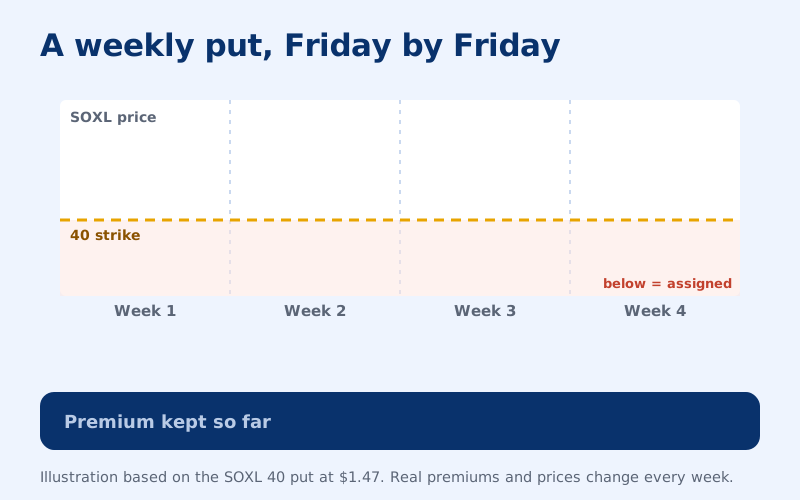
Here’s how a run of four weeks can play out. Three Fridays SOXL stays above $40 and you keep the premium each time. In the fourth week it closes below $40, so you’re assigned and switch to covered calls:
One more thing I always do: keep some extra cash on the side, around 20% of what you have at risk. On a $4,000 put, that’s about $800. If the market really turns upside down and you get assigned, that cash lets you buy more shares lower and bring your average cost down, which makes the covered calls easier to sell afterwards. Without it, you just sit there and wait for the stock to come back.
A word of caution on that, though: averaging down only makes sense on something you’d hold for years anyway. On a leveraged ETF in a long downtrend, it can mean putting more money into something that keeps falling. Decide on your limit before you trade, not in the middle of a selloff.
How much I made in May 2024
I keep a sheet of every options trade I make, all the profits and losses. When I filtered it by SOXL for May 2024, I had started on May 3rd, and I was trading two contracts each week, so each week had two entries.
After the first couple of weeks of May, the closed SOXL trades added up to a little over $500, with one more position still open.
That’s the power of this. You’re not waiting a month, and unlike a swing trade, you don’t have to sell anything to get paid. You’re just using your cash to keep generating income week after week.
To be fair, May 2024 was a strong month for chip stocks, so every one of those puts expired. Not every month will look like that, and a bad week can wipe out a few good ones. That’s why sizing and the cash cushion matter so much.
Is selling weekly puts right for you?
Here’s my honest checklist before you start selling weekly puts:
- Pick something you’d be happy to own. If you’d panic holding 100 shares of it, don’t sell puts on it. My guide on picking stocks for the wheel goes through what I look for.
- Check the options are liquid. Weeklies on smaller stocks can have wide bid-ask spreads that eat your premium.
- Look at the calendar. Earnings, Fed meetings, big news. Know what’s in your week.
- Have the full cash. A cash-secured put means the strike × 100 is sitting in your account. If that’s too much for you right now, a put credit spread needs a lot less. I showed one on QQQ in how to make $200 weekly with a small account.
- Start small. One contract, a calmer underlying, and see how it feels for a month before you scale up.
If you want to see the order screens on Robinhood, I walk through them in selling cash-secured puts on Robinhood. And if you have any questions, put them in the comments on the video. I do reply to all of them.
FAQ
Is selling weekly puts better than monthly?
Weekly puts usually collect more premium in total because time decay is fastest in the last week, and you get paid four times a month. The trade-off is more trades to manage and almost no time to recover if the stock drops sharply. Monthly puts are less work and give a bad trade more time to come back.How much money do you need to sell weekly puts?
For a cash-secured put you need the strike price times 100 in cash. A 40 strike put needs $4,000. If that's too much, a put credit spread on the same stock needs only the width of the spread.Is selling puts on SOXL safe?
Not really. SOXL is a 3× daily leveraged semiconductor ETF, so it can drop very fast and its losses compound over time. It pays high premiums for that reason. Only sell puts on it with money you can afford to have tied up for a long time, and size it small.What happens if my weekly put is assigned?
You buy 100 shares at the strike price on Friday, and you keep the premium. From there you can sell covered calls on those shares every week, which is the wheel strategy.Check your understanding
Written by Abhi
I'm Abhi. I've invested in US stocks for years, and for the last five to six years options have been at the heart of how I trade. I started AD Finance to break complex options concepts into plain-English guides, so you can trade with confidence, and I built OptionsVault to track my own trades.
This guide is for education only and is not financial advice. Options trading involves risk. Read the full disclaimer.