Key takeaways
- Before picking a strategy, answer three questions: which direction, is there a trend, and how volatile is the stock?
- Low volatility makes options cheap, which favours buying. High volatility makes premiums rich, which favours selling.
- If you sell options, look for balanced volatility in large and mega caps, not small caps with sky-high IV.
- Covered calls fit four of the six boxes in the matrix, and cash-secured puts are a close second.
Before you start: read Trading Options 101 and Vega Explained first.
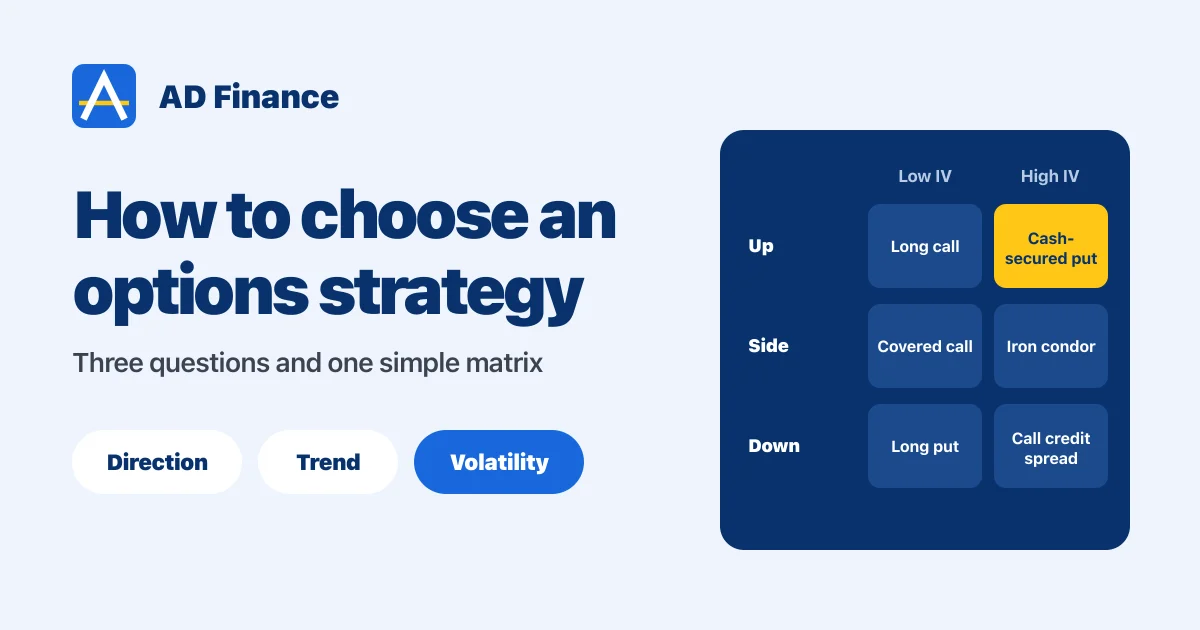
Which options strategy should I use? It’s the question I get asked more than any other. There are dozens of strategies out there, and it’s easy to feel like you need to know all of them before you can place a trade.
You don’t. Choosing an options strategy isn’t rocket science. You answer three questions about the stock, then look up the answer in one simple matrix. In this guide I’ll go through both, using a Robinhood article that lays it out really clearly, and add the rules I use on top of it in my own trading.
The 3 questions to ask before every trade
1. Are you bullish or bearish?
This is the biggest question, because it fundamentally decides which strategies are even on the table. Do you think the stock is going up, down, or mostly sideways? A bullish view leads to calls and put selling, a bearish view to puts and call spreads, and a neutral view to strategies that profit from the stock staying in a range.
2. Is there a trend?
Your view needs something behind it. Look at the chart and check whether the stock is actually trending, up or down, or moving sideways inside a range.
The indicator I like most for this as an option seller is Bollinger Bands. They draw a band around the price based on how much it has been moving, so you can see at a glance whether the stock is climbing, falling, or bouncing inside its range.
- Look at at least a year of chart to see the bigger direction.
- If you trade weekly options, also check the last couple of months.
3. How volatile is the stock?
Volatility plays a big role in the price of an option. The premium you collect or pay is mostly extrinsic value, and extrinsic value comes from two things: time and volatility. The more the market expects a stock to move, the higher its implied volatility, and the more its options cost.
That’s why dividend stocks usually pay so little premium. They barely move, so there isn’t much volatility to sell. As an option seller, you want volatility. But not too much.
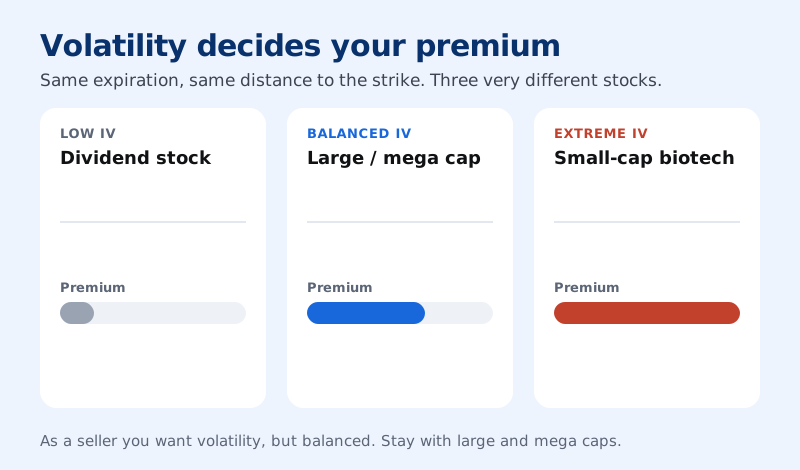
If a stock’s volatility is through the roof, there’s a reason. Small pharma and biotech companies are the classic example: huge premiums, but the stock can come crashing down on one piece of news, and then you’re bag-holding it for a very long time.
So here’s the rule I add on top of the article: when you go looking for volatility, stay with large and mega caps. You want balanced volatility on a solid company, not the highest premium on the screen.
The options strategy matrix
Once you’ve answered the three questions, picking the strategy is simple. Find your direction on the left and your volatility across the top:
| Stock direction | Low volatility | High volatility |
|---|---|---|
| Up | Long call, call debit spread, covered call | Cash-secured put, put credit spread, covered call |
| Sideways | Covered call, poor man’s covered call | Iron condor, covered call |
| Down | Long put, put debit spread | Call credit spread |
Here’s the same matrix in motion, so you can see how the three answers lead to one box:
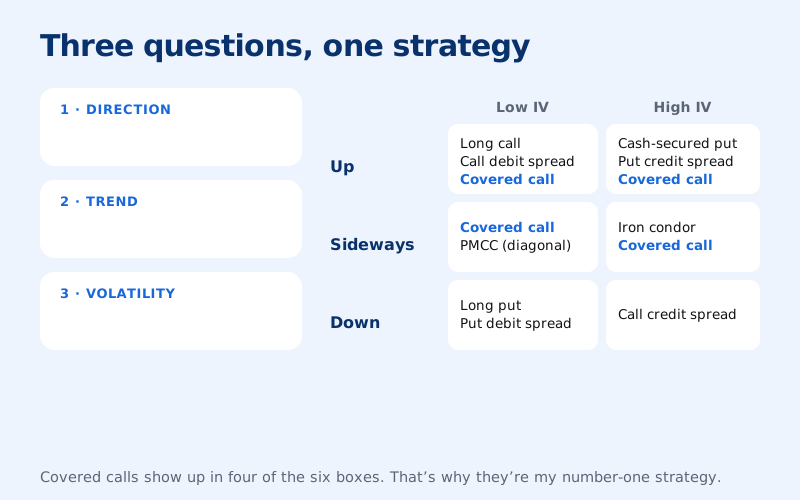
The logic behind the columns is the same everywhere. Low volatility means options are cheap, which favours buying them, because you don’t overpay for the contract. High volatility means premiums are rich, which favours selling them.
When the stock is going up
Low volatility: a long call or a call debit spread. You’re the buyer, so low volatility is your friend: you don’t pay too much for the contract. A covered call works here too.
High volatility: the cash-secured put, the put credit spread and the covered call. Now you’re on the selling side, collecting that rich premium. This is where my large and mega cap rule matters most.
When the stock is moving sideways
Use Bollinger Bands to check that the stock really is moving sideways inside its range.
High volatility: the iron condor. It’s a put credit spread and a call credit spread combined, so you’re protected on both sides. If the stock drops too far, you’re covered; if it rises too far, you’re covered. It won’t pay a big premium, but it has a good chance of profit as long as the stock stays in its range.
Low volatility: the covered call still works. The premium will be smaller, but you’re getting paid while the stock goes nowhere. If 100 shares are too expensive, a poor man’s covered call does the same job, and low volatility makes its long call cheaper to buy.
When the stock is going down
Low volatility: the long put or the put debit spread. Honestly, I don’t buy long puts very often. Even with low volatility, time decay keeps eating into what you paid for the contract, and you need a real, lasting downtrend to make it work. If you’ve seen a downtrend for at least the last couple of months, it can make sense.
For most people, especially with a small account, I’d pick the put debit spread over the long put. Your risk is limited, you put far less money on the line, and you still profit if the stock goes down. If you think a stock has run too high and needs to cool down, a weekly put debit spread is a good way to play it.
High volatility: a call credit spread, which sells a call above the price and buys a higher one for protection. You collect premium as long as the stock stays below your short strike.
Why the covered call keeps showing up
Look at the matrix again. The covered call shows up in four of the six boxes: up or sideways, low or high volatility. That tells you how many situations it fits.
That’s why the covered call is my number-one options strategy. Its risk is mostly the risk of owning the shares, which you’d carry anyway as an investor. My second pick is the cash-secured put. It’s the same idea from the other side, and if you put the two together you get the wheel strategy.
Putting it together: an example
Let’s run through it once. Say you’re looking at a large-cap tech stock.
- Direction. You’re bullish on the company for the next few months.
- Trend. On the one-year chart it’s been climbing, and over the last two months it’s been riding the upper half of its Bollinger Bands. That’s an uptrend.
- Volatility. Its implied volatility is higher than usual, but it’s a mega cap, not a small biotech. That’s the balanced kind of volatility you want.
Up plus high volatility points to the top-right box: a cash-secured put, a put credit spread if you want less capital at risk, or a covered call if you already own the shares. From there, the last step is choosing the strike, which I cover in how to select the perfect strike price.
If the same stock had low volatility instead, you’d move one column left: options are cheaper, so a call debit spread becomes the better fit.
A quick checklist
- Have a view. Up, down or sideways, before you open the option chain.
- Check the trend. A year of chart, plus the last couple of months for weeklies. Bollinger Bands make it easier.
- Check volatility. Low favours buying, high favours selling.
- Stay with large and mega caps when you’re chasing premium.
- Start with the covered call or the cash-secured put if you’re not sure. They fit the most situations.
If you have questions about any of these strategies, I have videos on most of them on my channel. Put your question in the comments on the video and I’ll reply.
FAQ
How do I choose the right options strategy?
Answer three questions. Are you bullish, bearish or neutral on the stock? Is there a clear trend? Is its volatility low or high? Direction and volatility together point to a box in the strategy matrix, for example a cash-secured put when you're bullish and volatility is high.What is the best options strategy for beginners?
The covered call. It fits the most market conditions and its risk is mostly the risk of owning the shares. The cash-secured put is a close second, because it's the same idea from the other side.Should I buy or sell options when implied volatility is high?
High implied volatility makes options expensive, so it usually favours selling them, with strategies like cash-secured puts, credit spreads and iron condors. Low volatility makes options cheaper, which favours buying calls, puts or debit spreads.How do I know if a stock is trending?
Look at the chart over at least the last year, and the last couple of months if you trade weekly options. Bollinger Bands help here, because they show the range the stock has been moving in and whether that range is rising, falling or flat.Check your understanding
Written by Abhi
I'm Abhi. I've invested in US stocks for years, and for the last five to six years options have been at the heart of how I trade. I started AD Finance to break complex options concepts into plain-English guides, so you can trade with confidence, and I built OptionsVault to track my own trades.
This guide is for education only and is not financial advice. Options trading involves risk. Read the full disclaimer.