Key takeaways
- If you bought an option and it's in the money at expiration, Robinhood tries to exercise it, as long as you have the buying power.
- If you don't have the buying power, Robinhood may sell it for you in the last 30 minutes of expiration day.
- Selling to close almost always beats exercising, because exercising throws away the option's time value.
- I usually close sold options at 75–80% of the profit, often on the Thursday before a Friday expiration.
Before you start: read Trading Options 101 and Options Trading Terminology first.
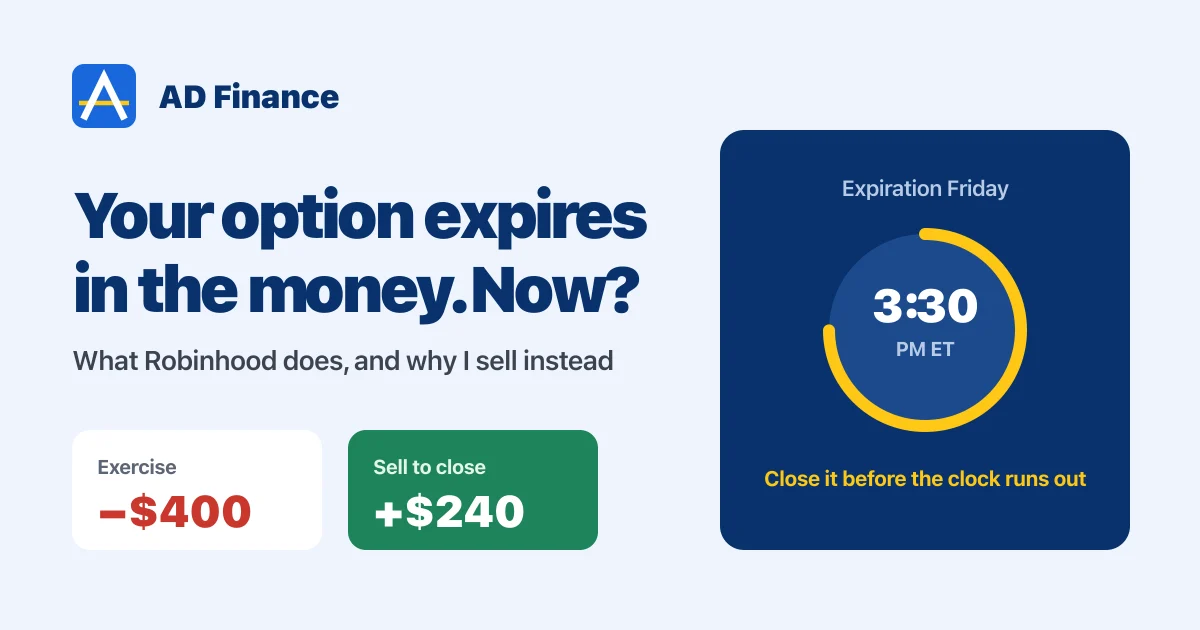
Your option is in the money, it’s Friday, and expiration is today. What actually happens if you just hold it? And should you exercise it, or sell it?
A lot of beginners mix up buying, selling and exercising an option, and it can cost real money. In this guide I’ll show you exactly what Robinhood does at expiration, why I almost never exercise, and how and when I close my options early instead. I’ll use two real positions from my account.
What happens when your option expires in the money
Here’s the short version. At the close on expiration day, an option is either in the money or out of the money:
- Out of the money: it simply expires worthless. If you bought it, you lose the premium you paid. If you sold it, you keep the premium.
- In the money, and you bought it: Robinhood will try to exercise it for you if it’s at least $0.01 in the money, as long as you have the buying power for a call (or the shares, for a put).
- In the money, but you don’t have the buying power: Robinhood may sell the option for you, usually in the last 30 minutes of the trading day.
- In the money, and you sold it: expect assignment. On a put, you buy 100 shares at the strike. On a call, you sell 100 shares at the strike.
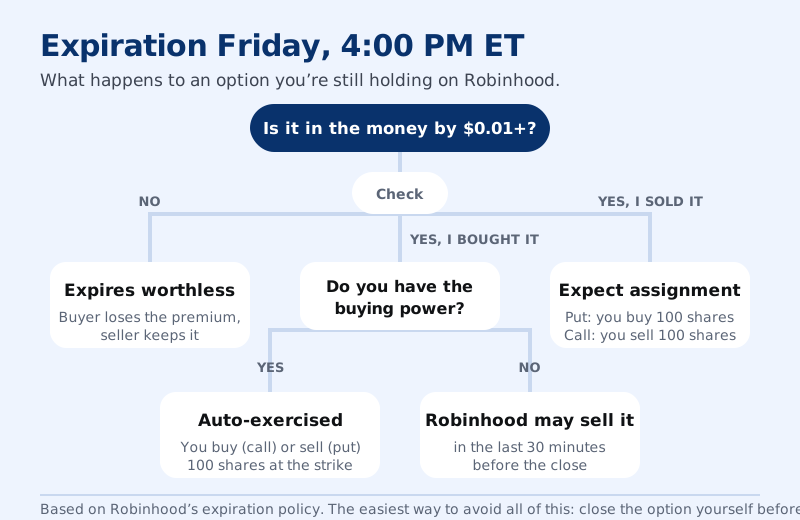
Pick the position you’re holding to see what happens to it:
You bought a call, and it's in the money
Robinhood will try to exercise it, which means you buy 100 shares at the strike price per contract. A 50 call means $5,000 per contract, so you need that much buying power.
Don't have it? Robinhood may sell the call for you near the close. Either way, you're better off selling it yourself before then. You get the full value, including any time value left.
You bought a put, and it's in the money
Robinhood will try to exercise it, which means you sell 100 shares at the strike price. If you own the shares, they're sold. If you don't, exercising would leave you short the stock, so Robinhood will generally sell the put for you instead.
Same advice as the call: sell to close before expiration and keep it simple.
You sold a covered call, and it's in the money
Your shares will most likely be called away at the strike price. You keep the premium, and you sell your 100 shares at the strike.
If you want to keep the shares, you can buy the call back or roll it out to a later date before expiration. I cover that in my covered calls on Robinhood guide.
You sold a cash-secured put, and it's in the money
You'll most likely be assigned 100 shares at the strike price, paid for with the cash you set aside. You keep the premium, which lowers your cost.
Happy to own the stock? Let it happen and start selling covered calls, which is the wheel strategy. Not happy? Buy the put back before the close.
One more thing to keep in mind: managing your positions is your job, not the broker’s. Robinhood’s automatic actions are a safety net, not a plan.
Why I almost never exercise my options
Let me show you with a real position. I had a Sysco 80 call expiring in January, a few months out. The stock was trading around $76, so the call was out of the money, and it still had about $2.40 of time value in it, $240 per contract.
When you tap Exercise on Robinhood, it doesn’t just let you do it. It asks you why, and gives you a few checks. That’s Robinhood telling you this is probably not what you want.
Here’s why. Remember what buying a call gives you: the right to buy the shares at the strike. If I exercise, I’m buying Sysco at $80 when anyone can buy it at $76 in the market. That’s $4 a share, $400, gone right away. And on top of that, I throw away the $240 of time value the option still has. Nobody pays me for it.
If I sell to close instead, someone pays me that $240.
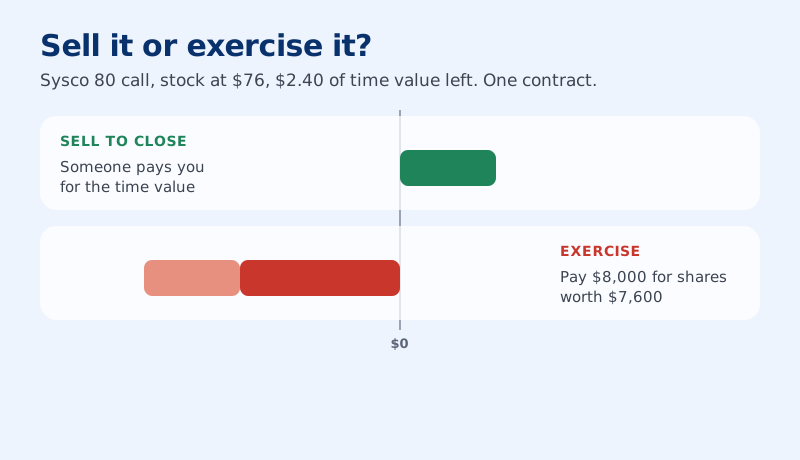
That’s a $640 difference on one contract, just from choosing the right button. The same logic applies to puts.
When exercising can make sense
Robinhood’s exercise screen lists a few real reasons, and they’re good ones:
- You need to cover an early assignment on a spread. If the short leg of your spread gets assigned, exercising your long leg can cover it.
- The bid-ask spread is very wide. On a thinly traded option, selling might mean giving away too much, so exercising and selling the shares can work out better.
- You actually want the shares, and there’s almost no time value left. A deep in-the-money call right before expiration is mostly intrinsic value, so you lose very little by exercising.
Outside of those, sell to close. Even with LEAPS months away from expiry, there’s usually a lot of time value you’d be leaving on the table.
Why I close my options before expiration
Now the other side. When I sell options, like a cash-secured put, I usually don’t wait for expiration either. There are three reasons:
- Taking profit. On one TQQQ 70 put I had open, I was already up around 42%, close to 50%, with more than a week left. Why wait a week for the rest? Take it.
- The market changed. Say you opened a position before earnings, when IV was high, and right after the report it dropped. Most of the profit may already be there, or the trade may have turned against you. Either way, it’s a good moment to close.
- Risk management. If a trade isn’t working, close it, take the small loss and move on to the next trade. Don’t hold and hope.
My general rule: I close when I’ve captured about 75–80% of the profit. And if expiration is on Friday, I usually close on Thursday. By then most of the time decay has already happened, so that last day gives you very little extra, with all the same risk.
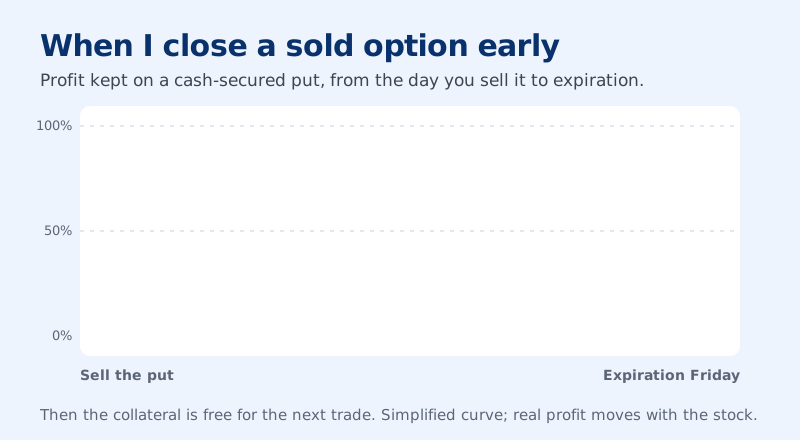
And when you close a cash-secured put early, the cash you had locked up as collateral is released right away, so you can use it for the next trade.
How to close an option early on Robinhood
Step 1 of 4
Open the position
Go to the stock, scroll to your options position and tap on it. You'll see the details: your average price, current value and the profit so far.
Step 2 of 4
Choose to close it
Tap Trade and choose to close. For an option you sold, like a cash-secured put, that's Buy to close. For an option you bought, it's Sell to close. Double-check you're not on "open", or you'll add a second position.
Step 3 of 4
Set a limit price
Enter the number of contracts and a limit price. When you're buying to close, you'll get filled fastest at the ask. Put it at the bid and it can sit there for a long time. Somewhere in between works if you're patient.
Step 4 of 4
Review and submit
Robinhood shows you what you're paying, and for a cash-secured put, that your collateral will be released. Submit, and once it fills, the position is closed and the cash is free.
My expiration-week checklist
Run through this on Wednesday or Thursday of expiration week:
Before expiration Friday
Nice. No surprises on Friday at 4 PM.
If you have questions about exercising or closing a specific position, put them in the comments on the video and I’ll answer.
FAQ
What happens if my option expires in the money on Robinhood?
If you bought it and it's at least $0.01 in the money, Robinhood tries to exercise it automatically, as long as you have the buying power for a call or the shares for a put. If you don't, Robinhood may sell it for you near the close on expiration day. If you sold the option, expect to be assigned.Should I exercise my call option or sell it?
In most cases, sell it. Selling to close gets you the option's full value, including its remaining time value. Exercising only gets you the intrinsic value and you lose the rest. Exercising can make sense when there's almost no time value left and you actually want to own the shares.Can I close an option before it expires?
Yes. On Robinhood you open the position and choose to close it, which places a sell-to-close order for an option you bought or a buy-to-close order for one you sold. Use a limit order. For a fast fill when buying to close, set your price near the ask.What happens if I don't have enough money to exercise my option on Robinhood?
Robinhood may sell the contract for you near the close on expiration day, usually in the last 30 minutes, and can act earlier depending on market conditions. If it can't be sold, Robinhood may ask for it not to be exercised, and it would expire worthless.Check your understanding
Written by Abhi
I'm Abhi. I've invested in US stocks for years, and for the last five to six years options have been at the heart of how I trade. I started AD Finance to break complex options concepts into plain-English guides, so you can trade with confidence, and I built OptionsVault to track my own trades.
This guide is for education only and is not financial advice. Options trading involves risk. Read the full disclaimer.