Key takeaways
- Rolling means buying back your option and selling a new one further out, in one order.
- Always roll for a credit: the new option should pay more than it costs to close the old one.
- On Robinhood, open the position and tap Roll this position. It defaults to one week out.
- Rolling isn't always the answer. Sometimes the right move is to close at a profit or let assignment happen.
Before you start: read Selling Covered Calls on Robinhood and Selling Cash Secured Puts on Robinhood first.
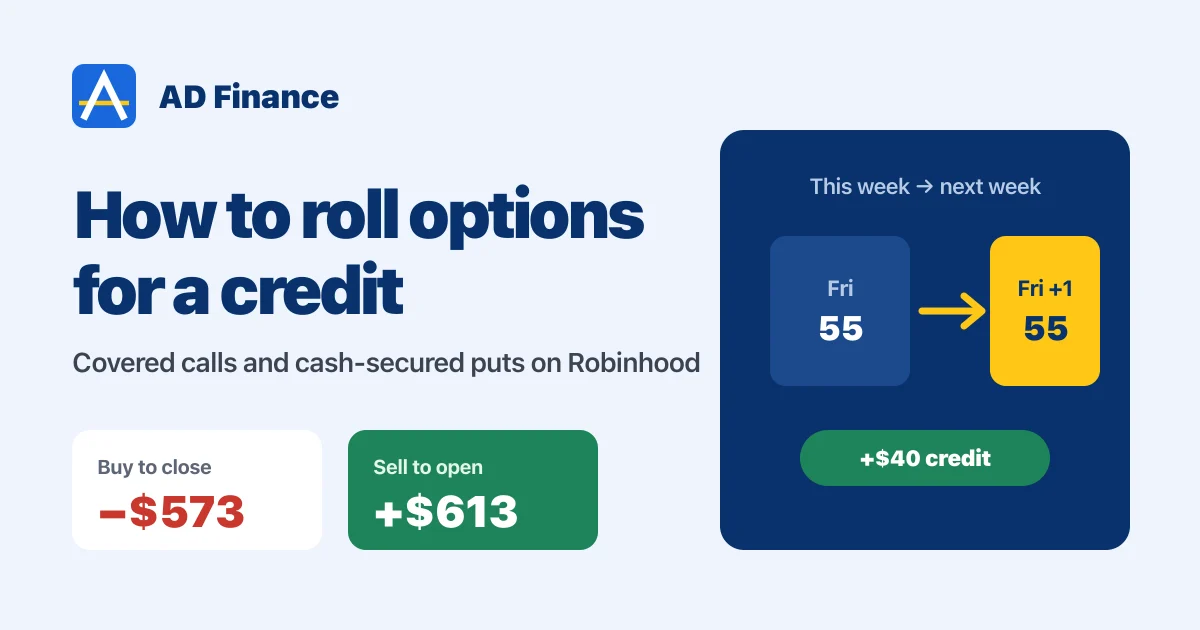
So your covered call is in the money, or your cash-secured put is going against you, and expiration is coming up. You don’t want to lose your shares, or you don’t want 100 more shares landing in your account. What do you do?
You roll it. In this guide I’ll show you exactly how I roll covered calls and cash-secured puts on Robinhood, the one rule I never break, and the times when rolling is not the answer. I’ll use real positions from my account: Nvidia, Palantir and TQQQ.
What rolling actually means
Rolling is two trades in one order:
- Buy to close the option you sold.
- Sell to open a new one, further out in time, and sometimes at a different strike.
You can roll out (later expiration), up (higher strike, for calls), down (lower strike, for puts), or a combination. On Robinhood it used to be a two-step process. Now there’s a Roll this position button that does both legs at once.
The one rule: always roll for a credit
When you roll, Robinhood shows you two numbers: what it costs to buy back the current option, and what you’ll collect for the new one. The new one should pay more. That’s a net credit, and it means you’re being paid to give the trade more time.
Here’s my TQQQ put from the video:
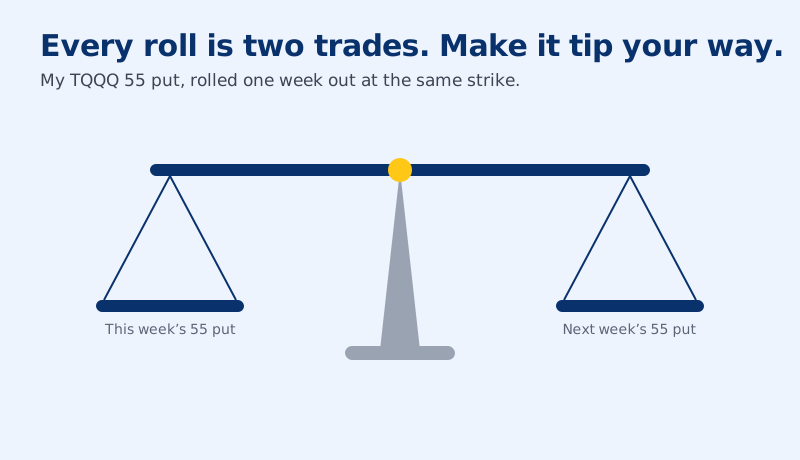
Why does that work? Time. Next week’s option has an extra week of time value in it, so it’s worth more than this week’s at the same strike. You’re selling that extra time.
The only time I’ll accept a small debit is when I’m rolling a put down to a lower strike to cut the chance of assignment. More on that below.
Rolling a covered call: my Nvidia example
Why roll a covered call at all? Two reasons:
- Taxes. If your shares get called away, that’s a sale. If it’s a big position with big gains, that can mean a big tax bill at the end of the year. Rolling keeps the shares.
- In-the-money calls. Sometimes, like in a bear market, you sell a call at or below your cost. If the stock spikes, you’d lose the shares and the capital difference.
I had sold an Nvidia 134 call, and Nvidia jumped. My return on it was negative, and if the trend kept going, my shares were getting called away. So I tapped Roll this position. Robinhood defaults to one week out. I kept the extra week but moved the strike up to 137, and it was still a credit. More time, a higher strike, and paid for it. That’s the ideal roll.
On a broker without a roll button, you do the same thing as a two-leg order: buy back the 134 call, and sell a call one week out, say the 135, and check the net is still a credit.
Rolling out and up when the stock really runs
Now a bigger move. Say you sold an Apple 185 call about 45 days out, and a week in, Apple rallies to $192. Buying that call back now costs a lot.
Instead, roll it out two or three weeks and up to the 190 strike. The extra weeks of premium pay for buying back the old call, so it comes out about even. What you’ve really bought is time, for Apple to cool off. Stocks rarely go up in a straight line.
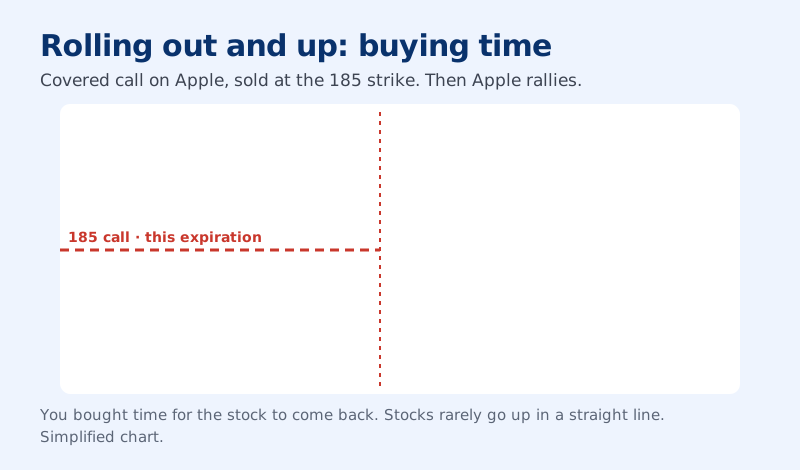
And if it pulls back below your new strike and you’re at 60–75% of the profit, close it. You just turned a losing trade into a winning one.
Rolling a cash-secured put: Palantir and TQQQ
Same idea, other side. With a put, rolling keeps you from being assigned 100 shares you don’t want right now.
When my Palantir 17 put went in the money, I had two choices on the roll screen:
- Same strike, one week out. Buy back for $94, sell next week’s 17 put for $116: a $22 credit. I do this when I think the market is still bullish overall and the dip is temporary.
- Roll down to 16.5, one week out. This cost me a $9 debit, but the lower strike gives Palantir more room. I do this when I think it could keep falling and I don’t want the shares.
And my TQQQ 55 put above: same strike, one week out, $40 credit. I already had one TQQQ position and didn’t want another 100 shares, so rolling made sense.
How to roll on Robinhood, step by step
Step 1 of 5
Open the position and tap "Roll this position"
Go to the stock, tap your covered call or cash-secured put, and choose Roll this position. Robinhood opens the chain with the next expiration already picked.
Step 2 of 5
Pick the new expiration
It defaults to one week out, but you can go two, three weeks or more. The further out, the more you collect. If the stock has moved a long way past your strike, you'll need to go further out to still get a credit.
Step 3 of 5
Pick the strike
Covered call: same strike, or move it up if you can still get a credit. Cash-secured put: same strike if you think it'll bounce, or move it down if you think it'll keep falling.
Step 4 of 5
Check it's a credit
Look at the two legs: buy to close and sell to open. The sell-to-open should be bigger. If the order shows a debit, try a later expiration or a closer strike until it's a credit.
Step 5 of 5
Set a limit price and submit
Robinhood doesn't allow market orders on rolls, so set a limit price for the net credit, review and submit. If it doesn't fill, nudge the limit a little closer to the middle.
Should you roll? Pick your situation
Rolling is a tool, not a rule. Here’s what I do in each situation:
The trade is working
Close it, don't roll it. Once I've captured 75–80% of the premium, most of the time decay has already happened. Buy it back, take the profit, and open the next trade with the freed-up cash.
The stock just crossed your strike
Roll out, for a credit. This is the sweet spot for rolling. One or two weeks out at the same strike, or a call up a strike, will usually still pay you a credit.
The stock blew through your strike
Roll further out, or let it go. You may need three weeks or more to roll for a credit. If even that doesn't work, it's often better to accept it. For a covered call, you keep the premium and sell at your strike, above your cost. That's still a profit. Then wait for the stock to come back and start again.
You'd be fine owning the shares
Take the assignment. If your put is in the money on a stock you'd happily own, let it happen and start selling covered calls on the shares. That's the wheel strategy. With a volatile stock that you think will bounce soon, the covered call premium can be better than rolling.
Before you roll: my checklist
Before I hit "Roll this position"
Good roll. You've bought time and got paid for it.
One last thing. Rolling doesn’t make risk disappear. It moves it into the future. If the stock you sold puts on has completely changed, its business, its trend, then taking the loss or the assignment can be smarter than rolling again and again. Be honest with yourself about that.
If you have a position you’re not sure whether to roll, put it in the comments on the video. I read all of them and I’ll tell you what I’d do.
FAQ
What does it mean to roll an option?
Rolling means closing your current option and opening a similar one with a later expiration, a different strike, or both, usually in one order. For a sold option like a covered call or cash-secured put, that's buy to close and sell to open.How do I roll a covered call on Robinhood?
Open the covered call position and tap Roll this position. Pick the new expiration and strike, check that the order shows a credit, set a limit price, and submit. On brokers without a roll button, buy to close the old call and sell to open the new one as a two-leg order.Should you roll for a credit or a debit?
Aim for a credit, so you're paid to take the extra time. The one exception I make is rolling a put down to a lower strike, where a small debit can be worth it to lower the chance of assignment.When should you not roll an option?
When the stock has moved so far past your strike that you can't roll for a credit anymore, when you've already captured most of the profit, or when you're happy with the assignment. Rolling isn't a fix for a stock you no longer believe in.Check your understanding
Written by Abhi
I'm Abhi. I've invested in US stocks for years, and for the last five to six years options have been at the heart of how I trade. I started AD Finance to break complex options concepts into plain-English guides, so you can trade with confidence, and I built OptionsVault to track my own trades.
This guide is for education only and is not financial advice. Options trading involves risk. Read the full disclaimer.